

Grow Tent Airflow: Which Direction Should Fans Point?

Last updated: August 2026
Quick answer: Start with the exhaust high, a passive intake low on the opposite side, and a separate circulation fan moving air gently through the canopy. The inline fan exchanges the tent’s air; the circulation fan prevents still, humid pockets around leaves. Do not reverse the whole layout because the tent crosses one fixed temperature.
Think of it like this: the inline fan changes the air in the room, while the small fan keeps the air already inside from sitting still. Once you separate those two jobs, grow-tent airflow becomes much easier to set up.
Watch: grow-tent airflow and fan direction
The original HWGrow video shows the basic high-exhaust and low-intake path. Keep that visual demonstration, but retire two spoken shortcuts: a fan does not create carbon dioxide, and 78°F is not a switch that tells you to reverse the ports. The updated workflow below uses the video as the source and explains where the room, humidity, plant stage and equipment change the answer.

Selecting a timestamp opens the standard HWGrow pop-out at that exact moment without making you lose your place on the page.
The simplest airflow layout that works
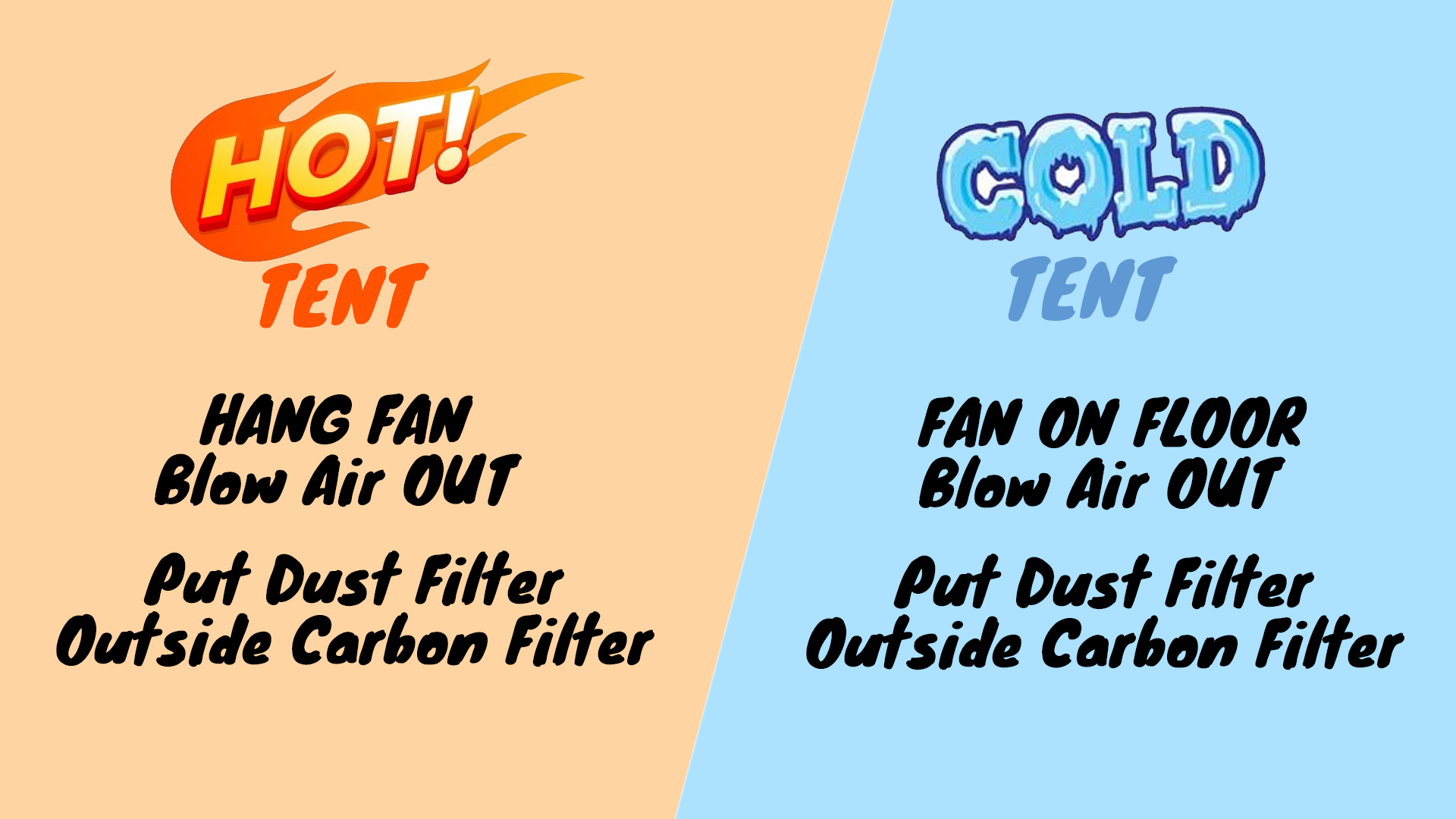
- Put exhaust high. Warm, moisture-loaded air usually gathers toward the top of a closed tent, so this is the cleanest starting point.
- Open a passive intake low and across the tent. Replacement air now travels through the grow instead of taking a short path straight back to the exhaust.
- Point a circulation fan across the canopy. You want leaves to move gently, not fold, taco or stay pinned by a hard stream of air.
- Measure at canopy height. Run the lights, exhaust and circulation fan together, then judge the system by temperature, humidity and what the leaves are doing.
- Adjust one thing at a time. Fan speed, intake area, room temperature, duct bends and filter restriction all change the result.

Exhaust and circulation are not the same job
| Fan job | What it actually does | Common mistake |
|---|---|---|
| Inline exhaust | Removes tent air and draws replacement room air through an intake. | Expecting it to fix a hot, humid room that has no fresh replacement air. |
| Circulation fan | Moves air around and through the canopy to reduce still pockets. | Blasting one side of the plant instead of creating broad, gentle movement. |
| Carbon filter | Adsorbs odors from the air that passes through it. | Treating it as a fan, a dehumidifier or a substitute for room ventilation. |
A tent fan cannot manufacture CO₂. It can replenish ambient CO₂ only by exchanging tent air with room air, and the room itself must also receive replacement air. If the exhaust dumps back into the same closed room, heat and humidity can circle right back into the tent.
Why the old 78°F reversal rule is retired
The video says to move exhaust low when the tent is below 78°F. That sounds simple, but it ignores humidity, plant stage, the lights-off environment and the surrounding room. Keep high exhaust and low intake as the default. If the tent is cool, first reduce exhaust speed, warm the room, adjust the light schedule or review the fixture setting. Reversing the ports can leave warm, humid air sitting above the canopy.
Use the separate cannabis temperature and humidity guide for stage-aware targets. The full grow-tent ventilation guide covers fan sizing, filters and duct resistance, while the outside-the-tent fan guide shows how to save headroom.
How to tell whether the airflow is working
- Slight negative pressure: the tent walls pull inward a little when the exhaust runs. Severe collapse means the fan needs more intake area or less speed.
- Gentle leaf movement: different parts of the canopy move without one section being hammered continuously.
- No dead corners: dense lower growth and the far side of the tent should not stay noticeably more humid than the canopy reading.
- Stable full-cycle readings: check the environment with the lights on and off. Humidity often becomes harder to control after the lights turn off.
- Useful room exhaust: sending tent air away from the intake side works better than recirculating it into the same closed room.
Plant-disease guidance from Penn State Extension connects good air circulation and lower relative humidity with reduced gray-mold activity. University of Minnesota Extension likewise recommends spacing and pruning to improve circulation where poor air movement favors powdery mildew. These are greenhouse and general-plant sources, so use them for the airflow principle—not as cannabis-specific temperature prescriptions.
Quick troubleshooting
- Hot tent: increase exhaust gradually, straighten duct bends and send the exhaust away from the intake side.
- Humid tent: confirm the surrounding room is drier than the tent, increase exchange and improve circulation through dense growth.
- Leaves look wind-burned: move the circulation fan farther away, aim past the canopy or reduce its speed.
- Weak airflow after adding a filter: the filter and duct added resistance. Clean the prefilter, inspect the duct and compare the fan/filter practical ratings.
- Odor leak: check whether the tent still has negative pressure and seal every joint before assuming the carbon is exhausted.
Recommended airflow tools
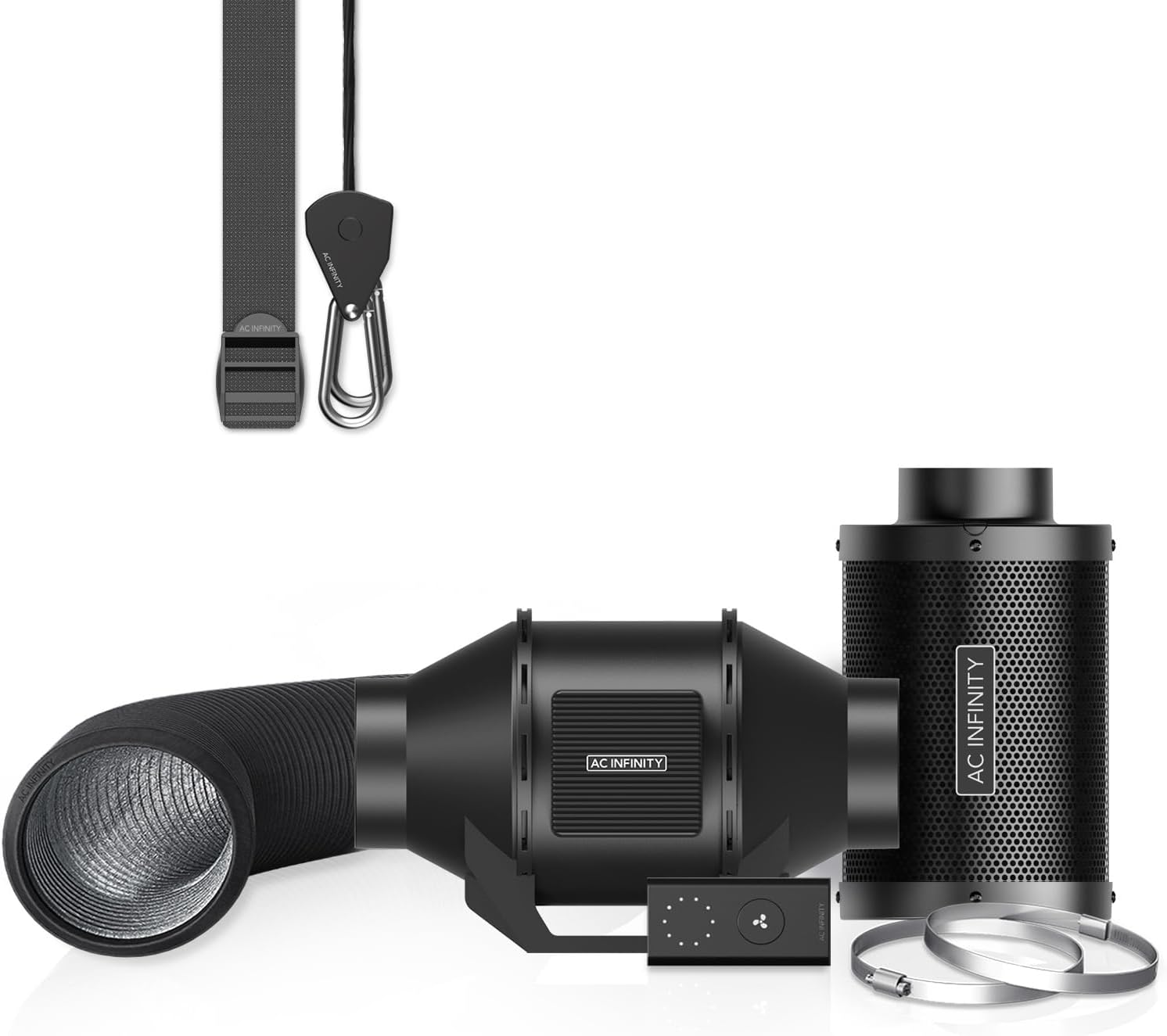
Inline fan and filter kitA straightforward exhaust starting point. Match the duct size, then allow for the real filter and duct resistance.

Oscillating clip fanCreates broad canopy movement without aiming one hard stream at the same leaves all day. Verify the current generation and warranty.

Thermometer and hygrometerUse a separate canopy reading to confirm whether fan changes actually improved temperature and humidity.
AC Infinity savings: Use code EVYGROWS for additional savings on eligible products. When shopping on Amazon, clip any available coupon first.
Affiliate disclosure: HWGrow may earn a commission from qualifying purchases at no additional cost to you. Product generations and destinations can change. Verify the current seller, specifications, return terms and final cart price.
Frequently asked questions
Which way should an inline fan point in a grow tent?
Follow the arrow on the fan housing. In the normal exhaust layout, the arrow points away from the tent and toward the final exhaust destination.
Should grow-tent exhaust be at the top or bottom?
Start high, with a passive intake low on the opposite side. This removes warm, humid air from the ceiling area and gives replacement air a useful path across the grow.
Should a fan blow directly on cannabis plants?
Use broad, gentle air movement. Leaves can move slightly, but a strong stream that folds, dries or pins the same leaves all day is too aggressive.
Does a grow-tent fan add carbon dioxide?
No. It exchanges air. Replacement room air can restore ambient CO₂ only when the room itself has a source of fresh air.
Comments
Leave a reply
You may also like
How to Pheno Hunt Cannabis and Choose a Keeper
Hydroponic Water Chillers: Stop Summer Root Rot Before It Starts



Featured Grow
 Jul 2026 — White Iverson by Selfie Seeds +2 more
White Iverson × Selfie Seeds, Pink Strawberry × Selfie Seeds, Purple Berry × Selfie Seeds • Soil • Started Jul 25, 2026
View journal
Jul 2026 — White Iverson by Selfie Seeds +2 more
White Iverson × Selfie Seeds, Pink Strawberry × Selfie Seeds, Purple Berry × Selfie Seeds • Soil • Started Jul 25, 2026
View journal
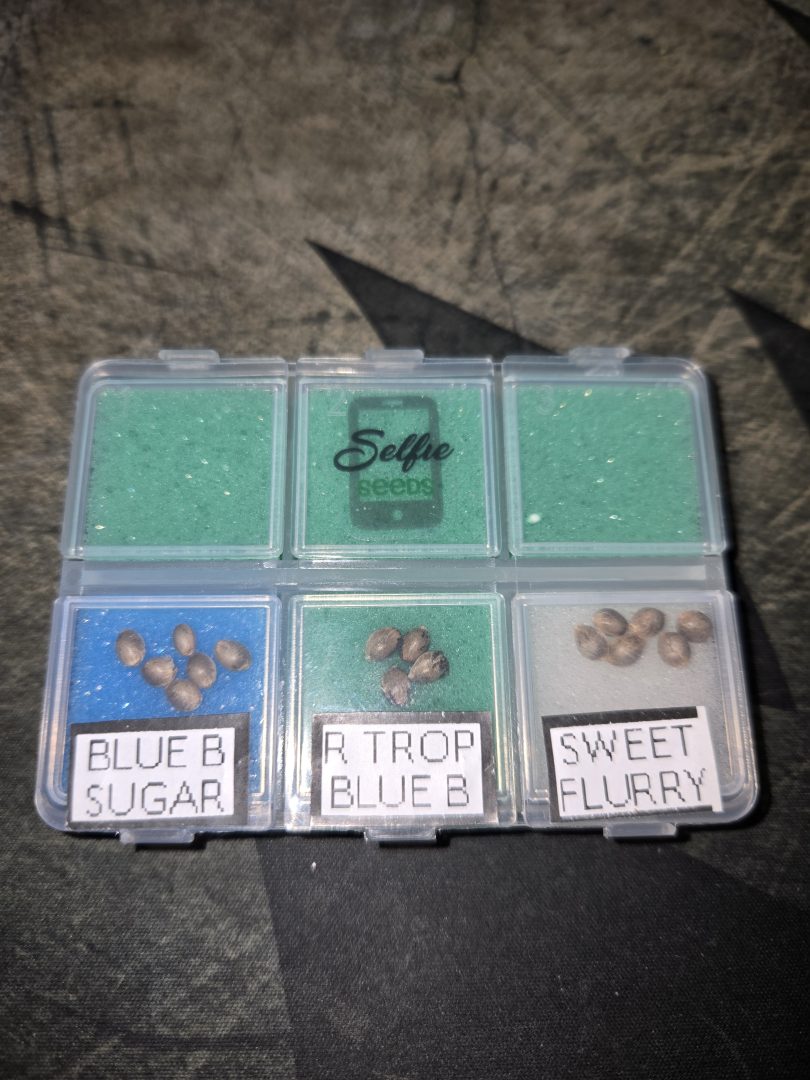 First Selfie Seeds Grow (Blueberry Sugar, Tropical Blueberry, and Sweet Flurry)
Blueberry Sugar × Selfie Seeds, Tropical Blueberry × Selfie Seeds, Sweet Flurry × Selfie Seeds • Soil • Started May 27, 2026
View journal
First Selfie Seeds Grow (Blueberry Sugar, Tropical Blueberry, and Sweet Flurry)
Blueberry Sugar × Selfie Seeds, Tropical Blueberry × Selfie Seeds, Sweet Flurry × Selfie Seeds • Soil • Started May 27, 2026
View journal
Awesome It’ll be a bit chlorophyllie but definitely let me know your opiniones

Walked in this morning before lights out and they are already bouncing back pretty good.
Awesome, fingers crossed for you
Nice LSTing Looks perfectly symmetric

Bananas!!!!! I knew I forgot something today. Thanks, gotta hit the store up in the am anyway. Coming off night,…
Straight to the point well explained subject matter. Brother, you have literally changed the game, taking power away from the major companies and putting it in the hands of people who just thought it was never possible to grow their own medicine.