

Photone vs. Apogee MQ-500: HWGrow PPFD Test Results

- 0:00 — Why I ran the comparison
- 0:45 — Phone and diffuser setup
- 1:15 — Experimental controls
- 2:27 — Minimum-power readings
- 2:52 — 50% power readings
- 3:17 — Full-power readings
- 3:42 — What the result chart showed
- 4:06 — Diffuser paper changed the answer
- 4:57 — Practical conclusion
Read the full video transcript
Now, for another episode of Wasting Money To Prove A Point, I present to you a $6 light meter app versus a $600 NASA approved light meter. If you follow any of my guides, you'll see I have the recommended light intensity all throughout different stages of growth. And it's extremely important that you follow this for the best results. Making sure that your levels are right starts with the tools you use to measure them.
Now, a lot of people clown me for using a phone app. And I get it. It looks bootleg. So now that I have this Apogee, let's see if you're right.
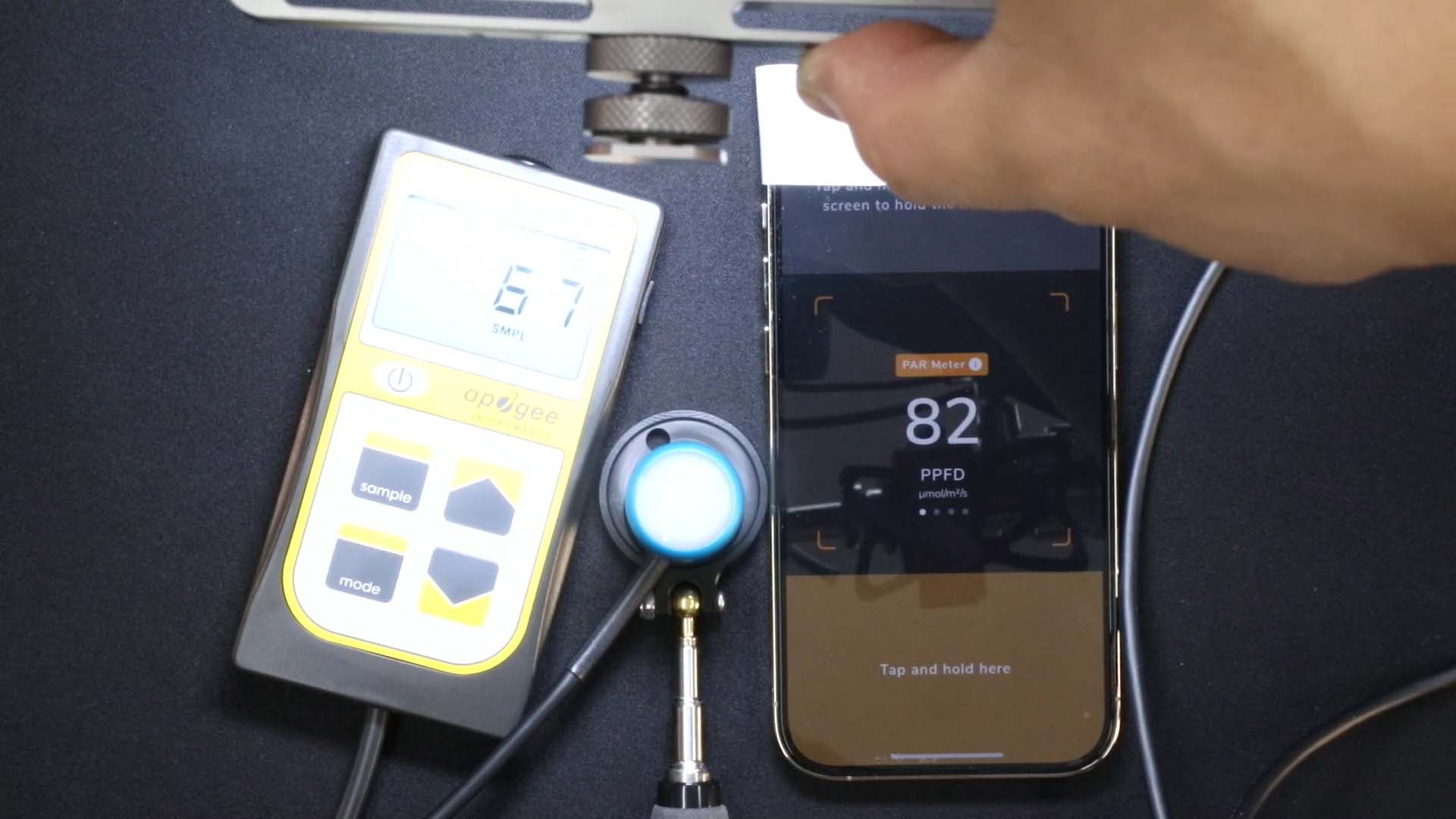
I've researched this app thoroughly. I even made my own tutorial on how to use it. And if you're iOS, you need to make a paper diffuser if it tells you. One of the things I discovered is the paper type actually makes a difference.
For Androids, the readings vary for every device. And as of this recording, the app is still in its beta phase. However, I was pleasantly surprised with the results. Anyhow, these are the controls to my test.
I have a 3 by 3 tent, my favorite light of all time, Spider Farmer SF2000, centered and exactly two feet up. On the floor, I have a spot marked for where I'll be measuring the light intensity using an Apogee MQ500, a Samsung S22 Ultra using Photone, an iPhone 14 Pro using Photone with Walmart paper, Staples paper, Epson paper, and for shits and giggles, IRS paper. Get back to the moon. All these devices have the app updated as of recording and no calibrations were made on any of them.
To make sure the readings were taken from the same distance from the light, I have this Govee box that elevates the phone's camera to the same height as the probe on the Apogee. A set of measurements was taken at minimal power, 50% power, and 100% power. So here's the readings for the minimal. See the Apogee, 69 PPFD, Epson, 77 PPFD, Walmart 89, Staples 74, IRS 108, and S22 Ultra 69.
At 50% light, Apogee 295, Epson 322, Walmart 374, Staples 313, IRS 448, and S22 Ultra 323. At 100% light power, Apogee's at 545, Epson 593, Walmart 686, Staples 573, IRS 840, and S22 Ultra 598. So here it is. These are the results.
It's worth mentioning that as stated on the manual, the Apogee may have a discrepancy of 5% straight out of the box. I had this data mapped out to a chart, and you could see it's linear, which is great, because now you could calibrate it using the video linked in the description. Apogee is the lowest readings. Next after that is going to be the iPhone with Staples paper, and then kind of even is the Epson, and then the Galaxy Ultra.
You could see that the Walmart and the IRS paper is off, so I definitely wouldn't recommend using that unless you calibrate. I find that the cheaper the paper is, the thinner, hence the higher readings. The fact that Photon actually reads higher than Apogee shows that the bootleg readings that I had on my light reviews are actually better than the actual readings, which goes to show that these lights that I said were bad were even worse than what I recorded them at. If a Staples is around you, the best paper I tested is the 22-pound bright white, which shows a discrepancy of 6%.
To save $600 for a 6% to 10% discrepancy is a no-brainer. And now that you have this data, you could calibrate your readings for better accuracy. If you enjoyed this tutorial, smash that like, hit that bell, and for more honest reviews and the best tutorials on how to grow weed, check out our site, hwgrow.com.
Quick answer: In my one-position, three-power-level test, Photone was close enough to the Apogee MQ-500 to be genuinely useful—but only with the right phone and diffuser. The Samsung S22 Ultra and the best iPhone paper setup read roughly 0–10% above the Apogee across the tested levels. The worst paper diffusers read 26–56% high. The lesson is not “every phone is accurate.” It is that setup and diffuser choice can matter more than the app price.
About this controlled comparison
I bought the Apogee because people kept clowning the phone app I used in my light reviews. Fair enough—the app looks too easy next to a professional quantum meter. So I marked one measurement spot, kept every sensor at the same height and compared all of them at minimum, 50% and 100% light power.

The exact PPFD results
Every number below is micromoles per square meter per second (µmol/m²/s), the standard PPFD unit. Positive percentages mean the phone read higher than the Apogee at that same point.
| Meter or diffuser | Minimum power | 50% power | 100% power |
|---|---|---|---|
| Apogee MQ-500 reference | 69 | 295 | 545 |
| Samsung S22 Ultra | 69 (0%) | 323 (+9.5%) | 598 (+9.7%) |
| iPhone + Staples 22 lb paper | 74 (+7.2%) | 313 (+6.1%) | 573 (+5.1%) |
| iPhone + Epson paper | 77 (+11.6%) | 322 (+9.2%) | 593 (+8.8%) |
| iPhone + Walmart paper | 89 (+29.0%) | 374 (+26.8%) | 686 (+25.9%) |
| iPhone + IRS paper | 108 (+56.5%) | 448 (+51.9%) | 840 (+54.1%) |
The good setups were reasonably linear: when the fixture output increased, their error stayed in a similar band. That makes them useful for repeatable home decisions. The bad paper did not create random noise—it created a consistently inflated answer. Consistent error is easier to spot and correct than a reading that drifts everywhere, but it is still error.
What this test proves—and what it does not
It proves that this exact phone-app setup tracked the reference meter well enough to map a home canopy. It also proves that grabbing any white paper is not a controlled method.
It does not prove a universal accuracy percentage for Photone. I tested one point under one fixture, with one unit of each phone, no custom calibration and three light-output settings. A stronger validation would repeat the comparison across a full canopy grid, several spectra, several phone samples and multiple sessions after the fixture reaches thermal stability.
The Apogee itself is not mathematically perfect. Its current specification lists ±5% calibration uncertainty, less than 0.5% repeatability and less than 2% long-term drift per year. That still makes it the much stronger reference because its diffuser, spectral response, cosine response and calibration are documented. See the current MQ-500 specifications.
How to use Photone correctly now
Photone has changed since this recording. Do not copy my old Android-versus-iPhone shortcut. The app now tells you which sensor mode and diffuser your exact device should use.
- Clean the phone’s camera or light-sensor area.
- Select the correct light-source spectrum in the app.
- Follow the on-screen diffuser instruction. Photone says every iPhone/iPad camera measurement needs a diffuser; supported Android camera measurements may also need one.
- Use the current paper instructions or the matched accessory diffuser—not whatever paper is nearby.
- Keep the phone level, at canopy height and in the same orientation for every reading.
- Map several points. One bright center reading does not describe the corners.
- Custom-calibrate only against a reference you trust.
Photone’s official device and diffuser guidance explains that supported camera measurements receive device-specific correction, while unsupported Android devices may fall back to a less accurate ambient-light sensor. The instruction shown inside the app should control.
When the phone app is enough
Use the phone when you are leveling one personal canopy, comparing relative changes, finding a dark corner or checking whether a height adjustment improved uniformity. A repeatable tool used across a grid is much better than guessing from hanging height.
Buy or borrow a documented quantum meter when you publish light reviews, compare different spectra, troubleshoot a commercial room, need repeatable records over years or want a trustworthy reference for calibrating other tools. The MQ-500 is expensive because it is a measuring instrument, not because every home grow needs one.
For the full grid method, PPFD-versus-PAR explanation and canopy-mapping workflow, use the complete LED grow-light measurement guide. That page owns the how-to; this page preserves the experiment and its exact numbers.
Light-measurement tools
Photone light-meter appThe affordable starting point for canopy mapping. Follow the current device, diffuser, spectrum and calibration instructions.

Apogee MQ-500 quantum meterThe documented reference option for repeatable PPFD maps, light comparisons and app calibration.
Affiliate disclosure: HWGrow may earn a commission from qualifying purchases at no additional cost to you. Verify the exact model, bundle, seller and current app requirements before buying.
Need help reading your map?
Ask HWGrow and include the fixture, power setting, hanging height, tent size, phone model, diffuser mode and a full grid of readings. The Grow With Me Masterclass connects light intensity with plant response without reproducing protected lessons here.
Photone vs. Apogee FAQ
Is Photone as accurate as an Apogee MQ-500?
It can be close on a supported, correctly configured phone, but this test does not prove equality for every device. The best tested phone setups read about 0–10% above the Apogee; the worst paper diffuser read more than 50% high.
Does Photone need a diffuser?
Follow the current in-app notice. Photone says iPhone and iPad camera measurements require a diffuser; supported Android camera measurements may also require one, while an unsupported ambient-light-sensor mode may tell you to remove it.
Which paper diffuser worked best in the HWGrow test?
Staples 22-pound bright-white paper was the closest of the four papers tested, reading about 5–7% above the Apogee. That 2023 result does not replace Photone’s current paper or accessory instructions.
Why buy an MQ-500 if a phone is close?
The MQ-500 has documented spectral and cosine response, calibration uncertainty, repeatability and long-term drift. That matters for published comparisons, commercial work and reliable records over time.
Comments
Leave a reply
You may also like
Best Grow Tent Humidifier: Why Young Plants Need More Humidity
How to Breed Masterclass – Promo Video



Featured Grow
 Jul 2026 — White Iverson by Selfie Seeds +2 more
White Iverson × Selfie Seeds, Pink Strawberry × Selfie Seeds, Purple Berry × Selfie Seeds • Soil • Started Jul 25, 2026
View journal
Jul 2026 — White Iverson by Selfie Seeds +2 more
White Iverson × Selfie Seeds, Pink Strawberry × Selfie Seeds, Purple Berry × Selfie Seeds • Soil • Started Jul 25, 2026
View journal
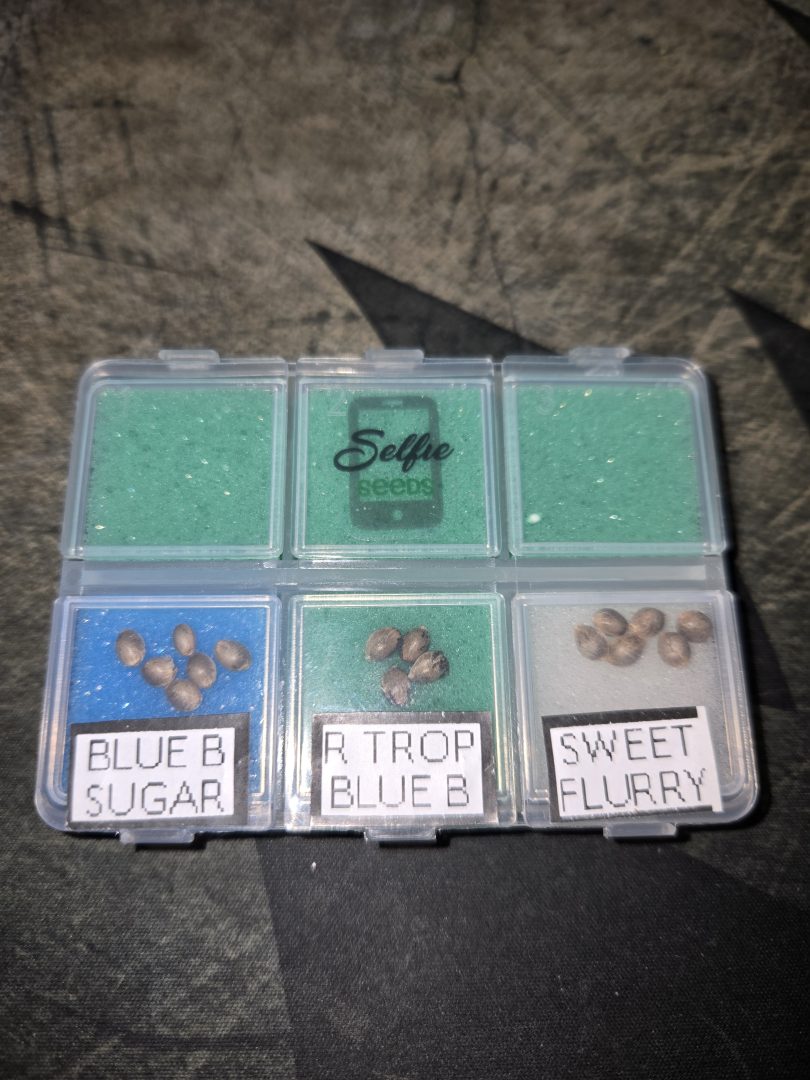 First Selfie Seeds Grow (Blueberry Sugar, Tropical Blueberry, and Sweet Flurry)
Blueberry Sugar × Selfie Seeds, Tropical Blueberry × Selfie Seeds, Sweet Flurry × Selfie Seeds • Soil • Started May 27, 2026
View journal
First Selfie Seeds Grow (Blueberry Sugar, Tropical Blueberry, and Sweet Flurry)
Blueberry Sugar × Selfie Seeds, Tropical Blueberry × Selfie Seeds, Sweet Flurry × Selfie Seeds • Soil • Started May 27, 2026
View journal
Awesome It’ll be a bit chlorophyllie but definitely let me know your opiniones
Walked in this morning before lights out and they are already bouncing back pretty good.
Awesome, fingers crossed for you
Nice LSTing Looks perfectly symmetric

Bananas!!!!! I knew I forgot something today. Thanks, gotta hit the store up in the am anyway. Coming off night,…
I’m pretty sure you’ve just saved a lot of folks a lot of money. Lord knows I’d be willing to spend it if I thought it would help improve the quality of my crop. Good lookin out bro.
anytime, hows your grow going?