

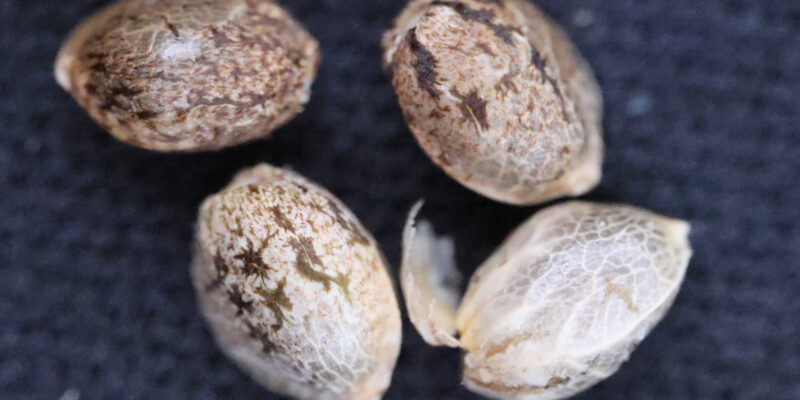
Cannabis Seed Patterns: A Mother’s Signature, Not a DNA Test

You can spend real money on a name printed on a seed pack, which is a little uncomfortable when the label is doing most of the talking. In the video below, I point out something people often overlook: the seeds themselves have patterns, colors and surface textures worth paying attention to.
When I call that pattern a fingerprint, I am talking about a characteristic look I have repeatedly observed across dozens of crosses from the same verified receiver clone, with different pollen donors. That is a more specific comparison than two packs sharing a strain name, and it is the reason I started paying attention when purchased seeds did not match what I was seeing.
Watch: what I noticed in the seeds
Original HWGrow video, approximately 3 minutes. Captions were imported from YouTube’s automatic English transcript. Cultivar names may contain recognition errors. The article separates my observations from what published research can establish.
What I observed across dozens of crosses
This was not one pack that looked a little different. I have a verified cut, and across dozens of crosses involving that same receiver clone and different donors, I have consistently seen the same characteristic seed pattern. By “the same,” I mean the recognizable type of markings, not that every stripe occupies the exact same spot on every seed. The donor changed; that recurring maternal look stayed consistent in my examples.
The video shows some of what I am describing, including the squiggly markings I associate with Tropicana Cherry, the more dotted, greenish appearance I describe for Blueberry Sugar, and examples where the patterned outer covering appears to have come away. My account also includes the broader set of crosses I have observed beyond those shown on camera.
Then I purchased seeds from several breeders or sellers that listed the same receiver as the verified cut I have, yet their seed patterns looked completely different. Based on that repeated comparison, I concluded that those purchases were not the genetics being advertised. That is my conclusion from my observations, not independently confirmed parentage or a scientifically validated test for every seed on the market.
Part of what makes me suspicious is how quickly popular and hype genetics seem to become available from everyone. A name gets hot and, apparently, the entire industry got the same invitation overnight. Sudden availability is not proof by itself, but it is why I want more to go on than a fashionable name on a packet. I am not naming the sellers because I am concerned about backlash and threats.
Cross names: receiver first, donor second
The usual pedigree convention reads seed parent × pollen parent. In plain English, the receiver is the plant bearing the seeds and the donor supplies pollen. My shortcut in the video is “ladies first.” The useful part of the shortcut is remembering which parent occupies which position, rather than assuming a product name contains the whole family tree.
So a label written Parent A × Parent B, when it follows that convention, identifies A as the receiver and B as the donor. Reversing the order describes the reciprocal parentage. This is a longstanding botanical naming convention, illustrated in the American Rhododendron Society’s registry rules. It is not a guarantee that every commercial label follows it. A clear record should explicitly identify both roles.
Why the outside has a maternal connection
A seed is not one genetically uniform object. The embryo develops from contributions from both parents, while the true seed coat develops from the mother’s ovule tissues. In flowering plants, the endosperm is another compartment with its own parental contribution. Calling the outside maternal does not mean the plant inside inherits only its mother’s genes.
That distinction is established developmental biology. In Figueiredo and colleagues’ Arabidopsis research, signals from the developing endosperm helped drive development of the maternal seed coat. The tissues interact; they are not sealed genetic islands.
Cannabis adds a naming wrinkle. What we casually call a seed is botanically a small dry fruit, an achene. Its fruit wall, or pericarp, surrounds the actual seed, and a thin floral covering called the perianth can remain outside it. Canada’s botanical account of Cannabis sativa specifically links mottling to irregular pigmentation in that persistent covering.
The outer tissues belong to the seed-bearing plant. That gives the maternal-signature idea a biological basis. It does not establish that every individual marking is copied exactly, that a strain has an exclusive pattern, or that pollen parentage can never influence any aspect of seed development.
Why the patterned “skin” can come away
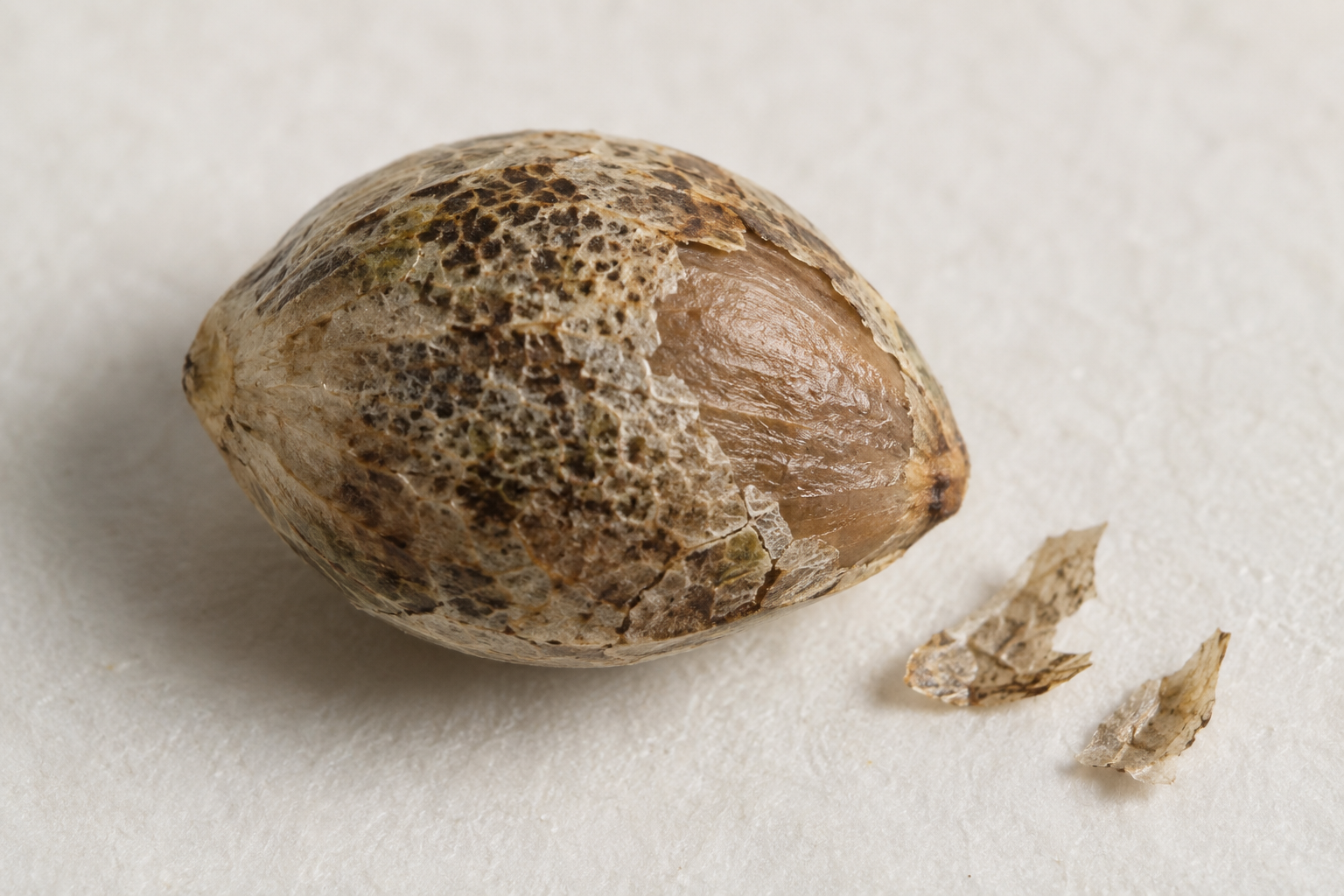
When I say “skin,” I am describing the thin surface layer I can see coming away, not a formal anatomical diagnosis from the video. The Canadian account describes variation in how closely the perianth adheres and whether it sloughs off. That supports the general observation that losing an outer covering can change the visible pattern.
My observation is that some examples lose that layer more readily than others. A phenotype is an observable characteristic, and differences between maternal plants could contribute to differences in surface appearance. However, I did not find a controlled cannabis study establishing a peelability ranking for the phenotypes shown here. Handling, surface wear and developmental condition are other possible explanations, not things I can rule out from a close-up.
That means a plain-looking surface is not automatically a fake, and it is also not proof that “the skin fell off.” Both conclusions go further than appearance alone allows.
What published research adds to the observation
There is good research in other plants supporting a genetic contribution to seed appearance. Parker and colleagues’ 2024 common-bean study connected seed color patterns with genetic regulators and temperature. Their work included several genetic populations, field comparisons of seven partly colored varieties across four locations, and a separate temperature experiment. Both genotype and environment mattered.
Another study examined 295 yellow-bean genotypes over two years in Michigan and Nebraska. It found genetic associations with appearance, but also significant genotype-by-environment effects on color. Seeds from Michigan were darker than those from Nebraska. A plant does not need to change its name to change its shade.
These are bean results, not proof of a cannabis authentication method. They support a more careful statement: seed appearance can reflect genetics while still varying with environment and condition. “Characteristic of this material” and “unique to this genetic identity” are different claims. The latter would require a validated comparison against other material, including an error rate.
There is also a generation issue. The coat on a particular seed belongs to the plant that produced it. A later descendant is a new maternal plant with its own genotype. A similar pattern across generations is interesting, but the maternal origin of the coat does not promise a permanently identical design.
Seed size has more than one author
I also want to separate size from the fingerprint idea. Nutrition and developmental timing are plausible influences, but saying size is determined by feeding and pollination timing alone leaves out genetics, seed position and the developing offspring.
A 2017 study of Peucedanum oreoselinum, a plant in the carrot family, found seed-mass variation associated with position and maternal growing conditions, including relationships with soil and seed nutrients. A two-year cotton experiment likewise found that maternal conditions and nutrient treatments could affect seed mass. These support the broad resource-allocation idea, not a cannabis feeding formula.
The donor cannot be erased from the size discussion either. In an Arabidopsis experiment, some pollen-parent genotypes affected seed mass, with the largest reported paternal effect producing seeds 15.3% heavier than the self-pollinated comparison on the same maternal background. That is a species-specific finding, not a percentage to apply to cannabis.
Developmental age at observation is another variable. Pollination timing can change how much development has occurred by a given comparison date, but I did not verify a cannabis study isolating that factor for the examples in this video. I would present it as a possible explanation to investigate, not as a proven cause. A larger seed is not automatically more authentic, and a smaller one is not automatically inferior.
Look closely, then ask better questions
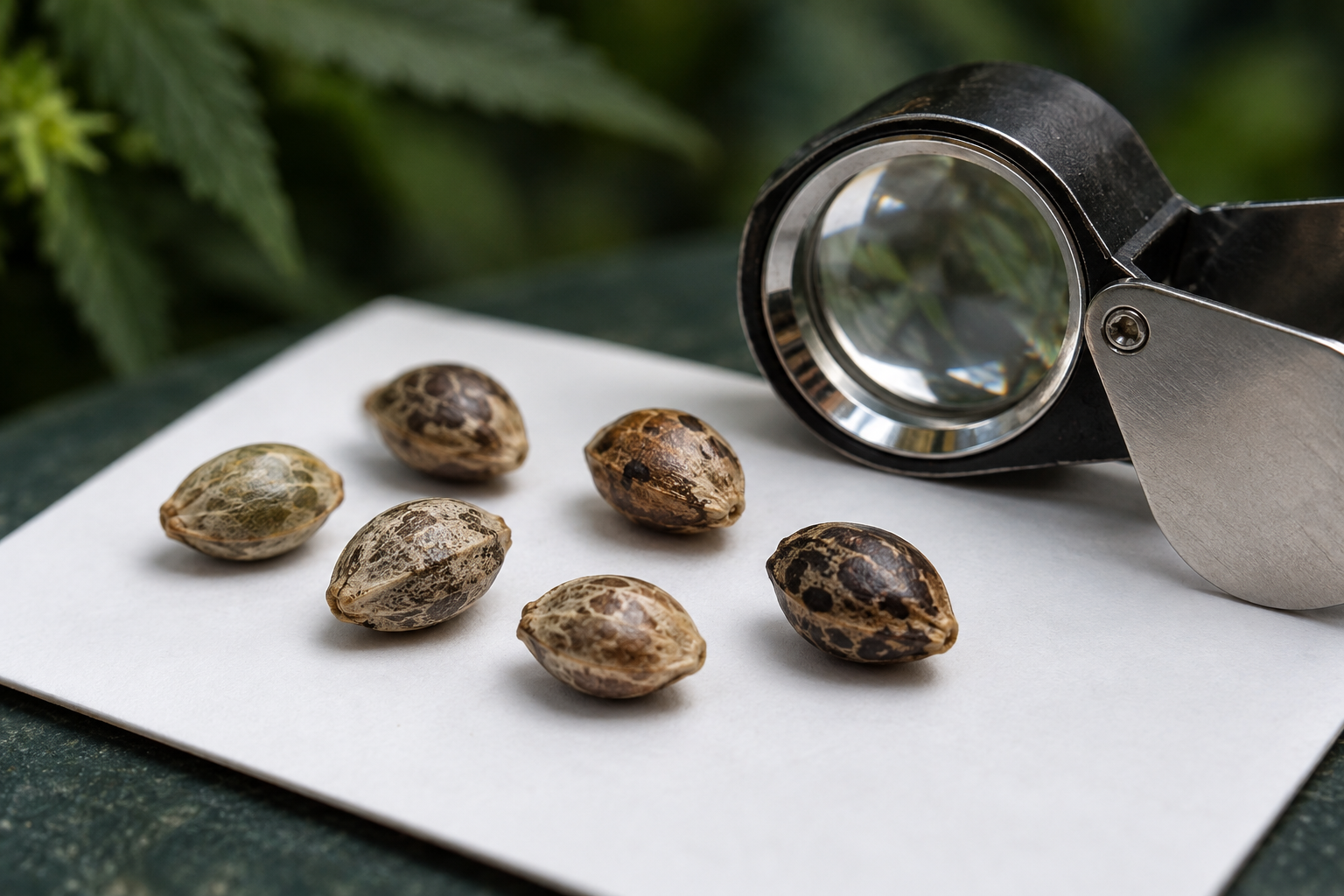
A loupe is useful because it makes small details easier to see. Consistent lighting, a plain background and a size reference make photographs easier to compare. Keep the label, source and date with the image so you know what you are actually comparing. A beautiful macro photograph without provenance is still just a beautiful macro photograph.
If something looks inconsistent, ask for clarification about the named parents and the material’s documented origin. My repeated same-clone comparisons are why I take these differences seriously. For readers assessing their own purchases, appearance is a reason to investigate the label and its supporting records; it cannot independently confirm or exclude parentage.
Frequently asked questions
Does the mother determine the seed pattern?
The visible outer tissues are maternal in origin. In my own observations across dozens of crosses, the same receiver clone produced the same characteristic pattern despite different donors. That recurring appearance is distinct from an identical arrangement of every marking, and published research has not established it as a universal parentage test.
Can two different crosses have similar-looking seeds?
Yes. Similar outer appearances can occur despite different parentage. The outer tissues and the embryo are not the same genetic compartment. A visual match does not identify the pollen donor.
Is receiver × donor the same as mother × father?
It describes the seed-bearing and pollen-supplying roles. The usual written convention puts the receiver first. Confirm how the author uses the notation rather than relying on a name alone.
Do stripes prove a seed is genuine?
Matching stripes alone cannot authenticate a seed. My concern came from repeated comparisons with the same verified receiver clone and mismatches across purchases from several sources. I did not find a validated cannabis authentication test based on those visible traits.
Why can the pattern disappear?
Loss or wear of an outer covering is one explanation. A plain surface does not, by itself, tell you whether that happened or establish a seed’s identity.
Are color and size controlled only by genetics?
No. Research in other plants shows contributions from genotype, environment and development. Those studies explain why absolute visual rules are unreliable; they do not validate a cannabis-specific prediction for every trait.
Do the photos prove these claims?
No. The three new images are labeled AI illustrations. The video shows the original observations; the linked studies support the scientific discussion. Neither illustration nor observation replaces a controlled test.
Transcript
Read the imported English captions
Automatic YouTube transcript, preserved with timestamps. Recognition errors and unfinished final wording are retained rather than presented as a verified verbatim transcription. Scientific claims made in the recording should be read with the qualifications above.
0:00 There's a ton of fake seeds going
0:02 around. I'm not going to name names, but
0:05 one thing you need to know is seeds have
0:08 patterns. Okay? It's almost like a
0:11 fingerprint. If you take a look here, I
0:14 got some Selfie Seeds™, right? All of
0:17 these are going to have unique patterns.
0:20 You could see the color is different.
0:23 And if you zoom in, you'll see each of
0:25 these seeds have different patterns.
0:29 Right? This is tropicana cherry. You see
0:31 how it has that squiggly line pattern?
0:34 That pattern is a fingerprint for the
0:37 female. So when you have a cross, the
0:39 way the names work is tropical sea cross
0:42 GDK means that the mother is tropical
0:46 sea. So just remember it easy like
0:48 ladies first.
0:51 Now if I go over here, these are
0:54 blueberry sugar crosses.
0:57 You could see that same exact mother
0:59 plant which was tropical cherry is going
1:02 to have the same exact pattern.
1:06 So this is where the blueberry sugar was
1:09 the donor. And if I find tropical cherry
1:15 right across BBS,
1:18 this pattern is identical. These seeds
1:22 look the same. So, when you got people
1:24 out there claiming that they got
1:26 tropical cherry Selfie Seeds™ or S1s, it
1:30 has to have this exact pattern. There is
1:33 no way of faking that. And I see these
1:36 seeds out there and I've purchased some
1:38 of them where they label them tropical
1:40 cherry and they're not real. The same
1:44 applies with BBS, blueberry sugar. All
1:46 right, this one has a very distinct
1:49 green pattern on it. not squiggly,
1:52 almost like little dots on them. And
1:55 that's blueberry sugar. Even the S2s
1:58 that I created, which has less leaves,
2:01 have a similar pattern, and that's
2:04 carried over mostly by the mother. And
2:07 the other thing I wanted to mention is
2:09 that strains have skin. So if you take a
2:12 look at all this tropical cherry seeds,
2:14 you go close up and you could see some
2:18 of them are solid and some of them have
2:20 pattern. That's because the skin peeled
2:22 off. The key is if it has a different
2:26 pattern than what you've seen on other
2:28 strains with the same mother, that's
2:30 when you know it's fake. If it's solid
2:33 and it doesn't have a pattern, that just
2:36 means the skin fell off. I just wanted
2:38 to teach you this because lately there's
2:41 a lot of breeders out there selling
2:42 whatever. They know that the ban is
2:44 coming and they're going to sell you
2:47 whatever they want. So, I'm just giving
2:50 you a heads up. Also, if you want to
2:53 learn how to breed like a pro, check out
2:55 my master class on my site. It's going
2:57 to teach you everything you need to know
3:00 from A to Z with dated
Sources and what they support
- HWGrow: Don’t Get Scammed: How to Identify Real Cannabis Seeds. Original observational video, not a controlled study.
- Canadian Food Inspection Agency, The Biology of Cannabis sativa L. Botanical synthesis describing achene anatomy, perianth pigmentation and adherence.
- American Rhododendron Society Plant Registry, Vol. 12, No. 4. Published example of maternal-first parentage notation.
- Figueiredo et al. (2016), Auxin production in the endosperm drives seed coat development in Arabidopsis. Experimental developmental biology, eLife.
- Parker et al. (2024), Seed color patterns in domesticated common bean. Genetic and environmental study, The Plant Journal.
- Sadohara et al. (2022; online 2021), Seed coat color genetics and genotype × environment effects in yellow beans. 295 genotypes, The Plant Genome.
- Effect of seed position and soil nutrients on seed mass in Peucedanum oreoselinum (2017). Scientific Reports.
- Effect of Plant Density, Boron Nutrition and Growth Regulation on Seed Mass in Cotton (2018). Two-year field experiment, Scientific Reports.
- de Jong et al. (2011), Paternal effects on seed mass in Arabidopsis thaliana. Experimental evidence of paternal effects, Plant Biology.
Research checked October 1, 2026. Evidence from other species is identified explicitly. Cover and inline macro images are AI-generated illustrations.
Useful tools for a closer look
A clear image and a reliable label are more useful than another oversized magnification claim. These are observation tools, not authenticity tests.
 Illuminated jeweler’s loupeA compact way to inspect markings and surface wear. Keep lighting consistent between specimens.
Digital microscope with standCompare options for capturing close-ups. Check device compatibility and stand stability before buying.
Photo gray cardA neutral reference for more consistent color photographs. It cannot correct every lighting or camera difference.
As an Amazon Associate, HWGrow earns from qualifying purchases. The microscope and gray-card links open product searches, not a personally tested model recommendation.
The masterclass mentioned in the video
You heard me mention my masterclass at the end of the video. Here is the link so you do not have to go hunting for it: HWGrow’s How to Breed Masterclass.
You may also like
Making the Strain: Pink Panty Cream, Episode 1 | Defining Desire
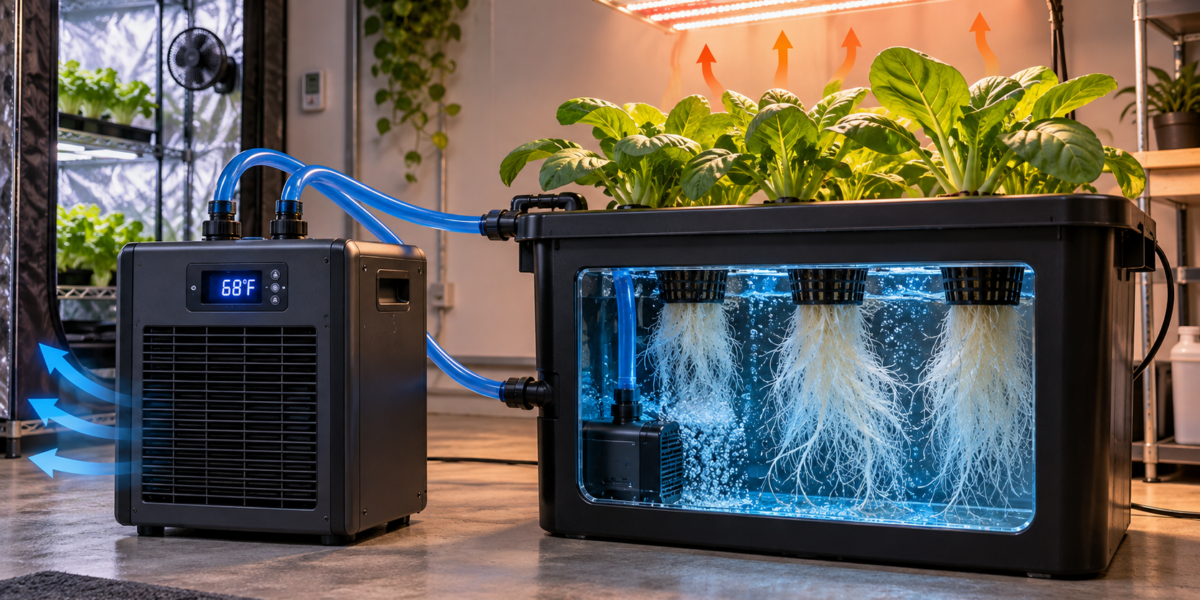
Hydroponic Water Chillers: Stop Summer Root Rot Before It Starts

Featured Grow
 Jul 2026 — White Iverson by Selfie Seeds +2 more
White Iverson × Selfie Seeds, Pink Strawberry × Selfie Seeds, Purple Berry × Selfie Seeds • Soil • Started Jul 25, 2026
View journal
Jul 2026 — White Iverson by Selfie Seeds +2 more
White Iverson × Selfie Seeds, Pink Strawberry × Selfie Seeds, Purple Berry × Selfie Seeds • Soil • Started Jul 25, 2026
View journal
 First Selfie Seeds Grow (Blueberry Sugar, Tropical Blueberry, and Sweet Flurry)
Blueberry Sugar × Selfie Seeds, Tropical Blueberry × Selfie Seeds, Sweet Flurry × Selfie Seeds • Soil • Started May 27, 2026
View journal
First Selfie Seeds Grow (Blueberry Sugar, Tropical Blueberry, and Sweet Flurry)
Blueberry Sugar × Selfie Seeds, Tropical Blueberry × Selfie Seeds, Sweet Flurry × Selfie Seeds • Soil • Started May 27, 2026
View journal
Looks great

I might deploy a trellis this run
I just ordered more yoyos
What is the banana supposed to do? And everytime I see a banana strain I have to buy it cause…
That stacking looks good.. once they swell OMG those buds are gonna be nut to butt