

DIY Push-Button Drip Irrigation for Indoor Plants
Drip-irrigation video chapters
- 0:00 — The push-button watering idea
- 0:18 — Smart outlet, pump and drip-kit parts
- 0:53 — How the reservoir feeds several outlets
- 1:19 — Cutting the main line with extra slack
- 2:25 — Connecting quarter-inch lines and emitters
- 3:10 — Connecting the pump and smart control
- 3:31 — Kinks, emitter aim and flow adjustments
- 4:36 — Outdoor-control option and rain delay

A small reservoir, a submersible pump and a simple drip manifold can water several indoor plants with one button—or on a schedule. The idea is easy. The part that matters is proving that every outlet flows evenly before you trust it with a grow.
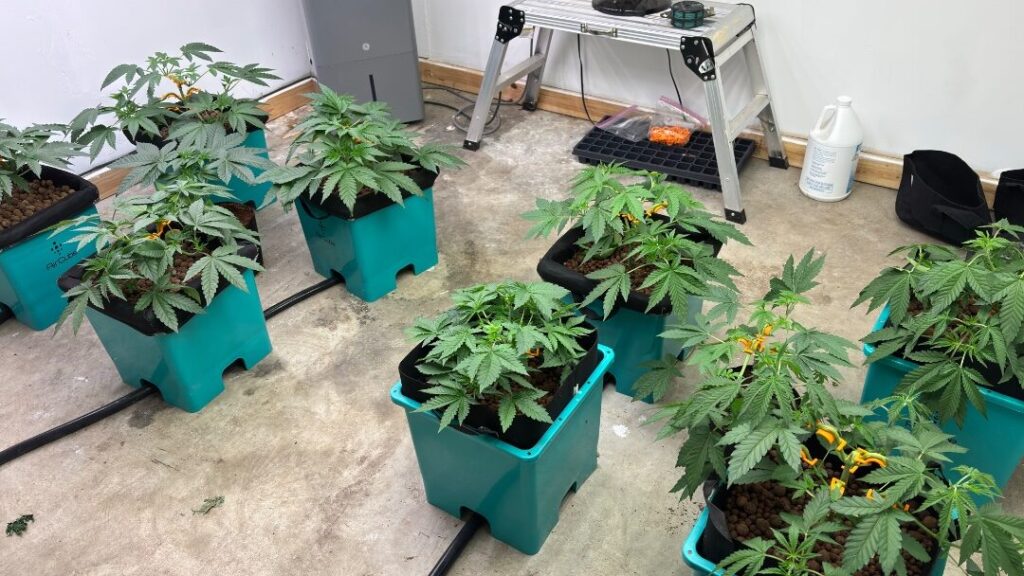
The original HWGrow build below uses a Wi-Fi-controlled outlet, a pump, main tubing and adjustable emitters. The exact hardware can change. Keep the layout, then size and test each part for your number of pots, lift height and desired watering volume.

How the system works
| Part | Job | What to verify |
|---|---|---|
| Covered reservoir | Holds the water or mixed feed. | Enough volume for the full cycle, no light leaks and no overflow path toward electricity. |
| Submersible pump | Moves liquid through the main line. | Real flow at your lift height, not just the advertised zero-head rating. |
| Main line and manifold | Splits the pump output into branches. | No kinks, loose barbs or unused open ports. |
| Quarter-inch lines and emitters | Deliver water to individual pots. | Similar line lengths and measured output at every pot. |
| Timer or smart outlet | Switches the pump on and off. | A local schedule still works as intended; remote access is a convenience, not the only safeguard. |
What you need
- A clean, opaque reservoir with a lid
- A submersible pump sized for the number of outlets and vertical lift
- Main tubing, a manifold or barbed tees, quarter-inch distribution tubing and end plugs
- Adjustable emitters, drip stakes or halos that fit the medium
- A timer or Wi-Fi outlet rated for the pump’s electrical load
- Catch cups or measuring containers for calibrating every outlet
- A GFCI-protected receptacle, drip loops and secondary containment
The video’s 550 GPH pump worked for that specific four-to-eight-plant arrangement. It is not a universal target. Every foot of lift, narrow fitting and extra branch reduces delivered flow. Choose enough head capacity for your layout, then use the measured outlet volume—not the box rating—to set run time.
Build it step by step
- Place the reservoir first. Keep it stable, covered and below electrical connections. Confirm that a leak cannot drain toward a receptacle or power strip.
- Lay out the main line. Route it from the pump to the manifold without a sharp bend. Leave extra slack; a line cut exactly to length is more likely to kink when a pot moves.
- Cut equal branch lines. Similar lengths reduce avoidable pressure differences. Soften stubborn tubing in warm water before pushing it over barbed fittings.
- Cap unused ports. One open branch can steal pressure from the rest of the system.
- Position the emitters. Wet the active root zone rather than one tiny spot against the stem. In a fabric pot, two or more delivery points can spread water more evenly than one fast dripper.
- Fill with plain water and leak-test. Run the pump while watching every fitting, bend and outlet.
- Calibrate before scheduling. Put an identical cup under every outlet and run the system for one minute. Measure each cup. Fix a large mismatch before deciding how long a real watering should run.
Set run time from measured volume
Do not copy a timer setting from someone else’s room. If one outlet delivers 250 mL in a minute and the pot needs about 1 liter for that event, the starting run time is roughly four minutes. Recheck the actual runoff and pot moisture, then adjust.
For fabric pots, the complete watering and feeding guide explains how to interpret saturation, runoff and dry-back. If nutrients are mixed into the reservoir, measure the solution with the pH, EC, PPM and runoff guide. To understand the starting water, search your ZIP code plus “water report” and compare the utility report with what your meter shows at the tap.
Before you trust it during a vacation
- Run several complete cycles while you are home.
- Verify the reservoir holds more than the scheduled total, with a safe margin.
- Make sure the pump never runs dry.
- Keep power connections above the reservoir and use drip loops.
- Place pots and the reservoir in trays that can contain a leak.
- Confirm lines cannot pop out of pots or fold when doors and tent flaps move.
- Check emitters for mineral or nutrient buildup and flush them between batches.
- Do not rely on an app screen as proof that water reached every pot.
Automation saves time, but it also repeats mistakes perfectly. A blocked emitter can leave one pot dry while the others look normal; a loose line can empty the reservoir onto the floor. Catch-cup tests and leak containment are what turn a clever setup into a dependable one.
Recommended irrigation components

Smart pump controlUse scheduled or manual push-button control while keeping the pump load within the outlet’s rating.

Submersible reservoir pumpChoose by measured head height, number of outlets and required flow—not one universal GPH number.

Drip tubing and emitter kitUse kink-resistant tubing, secure barbed fittings and enough delivery points to wet each container evenly.
Affiliate disclosure: HWGrow may earn a commission from qualifying purchases at no additional cost to you. Product destinations can be replaced with equivalent correctly sized parts without changing the irrigation method.
Need help matching the pump, number of pots and watering volume? Ask HWGrow a growing question and include your pot size, plant count, vertical lift and target volume per pot.
Frequently asked questions
What size pump do I need for drip irrigation?
Choose a pump that can deliver the needed flow at your actual vertical lift and through your fittings. The advertised GPH at zero head is not the same as the flow that reaches the emitters.
How do I know whether every pot gets the same amount?
Run each outlet into an identical measuring cup for the same length of time. Compare the volumes and correct kinks, line-length differences, clogs or emitter settings before watering plants.
Can I put nutrients in the irrigation reservoir?
Yes, if the nutrients are compatible with the system, but concentrated salts and organic material can settle or clog small emitters. Mix thoroughly, measure pH and EC when relevant, keep the reservoir clean and flush the lines.
Is a Wi-Fi outlet safe for unattended watering?
It can control the pump, but it does not prevent a loose line, empty reservoir or clogged emitter. Use GFCI protection, drip loops, leak containment and several successful test cycles before leaving the system unattended.
You may also like
Best Grow Tent Humidifier: Why Young Plants Need More Humidity
How to Pheno Hunt Cannabis and Choose a Keeper




Featured Grow
 Jul 2026 — White Iverson by Selfie Seeds +2 more
White Iverson × Selfie Seeds, Pink Strawberry × Selfie Seeds, Purple Berry × Selfie Seeds • Soil • Started Jul 25, 2026
View journal
Jul 2026 — White Iverson by Selfie Seeds +2 more
White Iverson × Selfie Seeds, Pink Strawberry × Selfie Seeds, Purple Berry × Selfie Seeds • Soil • Started Jul 25, 2026
View journal
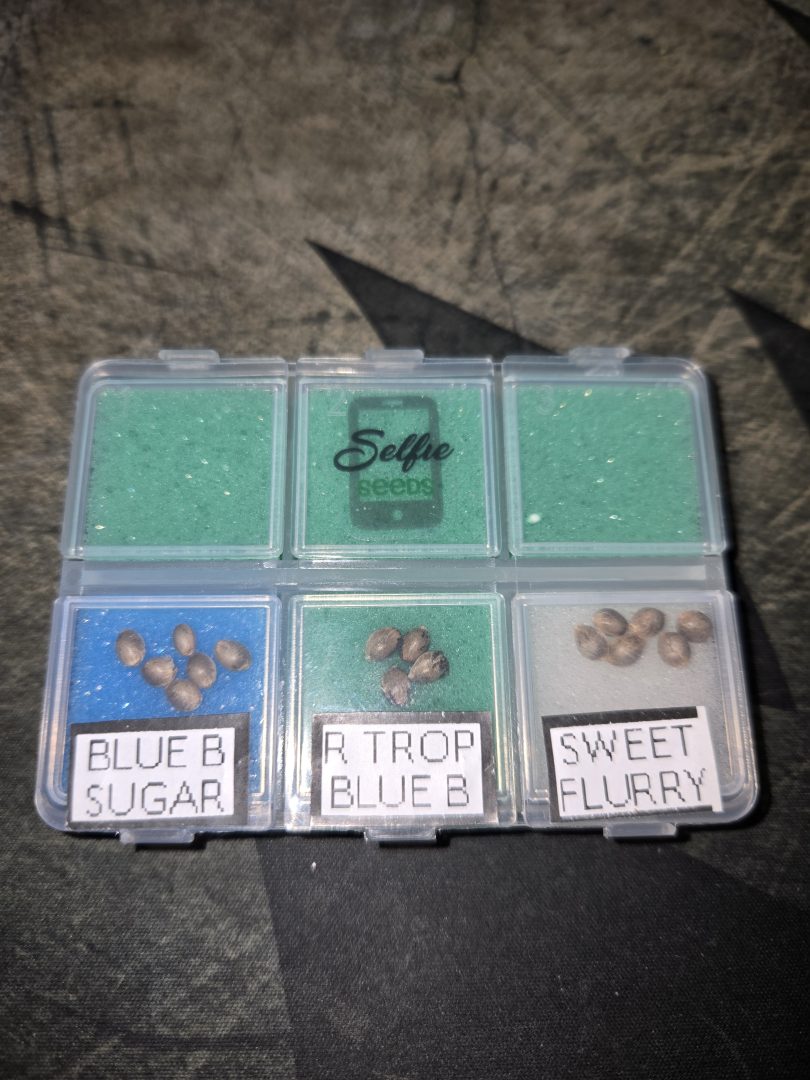 First Selfie Seeds Grow (Blueberry Sugar, Tropical Blueberry, and Sweet Flurry)
Blueberry Sugar × Selfie Seeds, Tropical Blueberry × Selfie Seeds, Sweet Flurry × Selfie Seeds • Soil • Started May 27, 2026
View journal
First Selfie Seeds Grow (Blueberry Sugar, Tropical Blueberry, and Sweet Flurry)
Blueberry Sugar × Selfie Seeds, Tropical Blueberry × Selfie Seeds, Sweet Flurry × Selfie Seeds • Soil • Started May 27, 2026
View journal
Awesome It’ll be a bit chlorophyllie but definitely let me know your opiniones

Walked in this morning before lights out and they are already bouncing back pretty good.
Awesome, fingers crossed for you
Nice LSTing Looks perfectly symmetric

Bananas!!!!! I knew I forgot something today. Thanks, gotta hit the store up in the am anyway. Coming off night,…