


General Hydroponics vs. FoxFarm Trio: Label & Workflow Comparison

Quick answer: General Hydroponics FloraSeries and the FoxFarm Soil Liquid Trio can both support a complete grow, but they are built around different labels and workflows. FloraSeries is a mineral three-part system whose ratios are changed by combining FloraMicro, FloraGro and FloraBloom. FoxFarm’s soil trio combines a conventional vegetative fertilizer, a low-analysis organic-based liquid and an acidic flowering concentrate. Choose the line that matches your medium and measuring habits—then follow the current official chart .
Watch my comparison
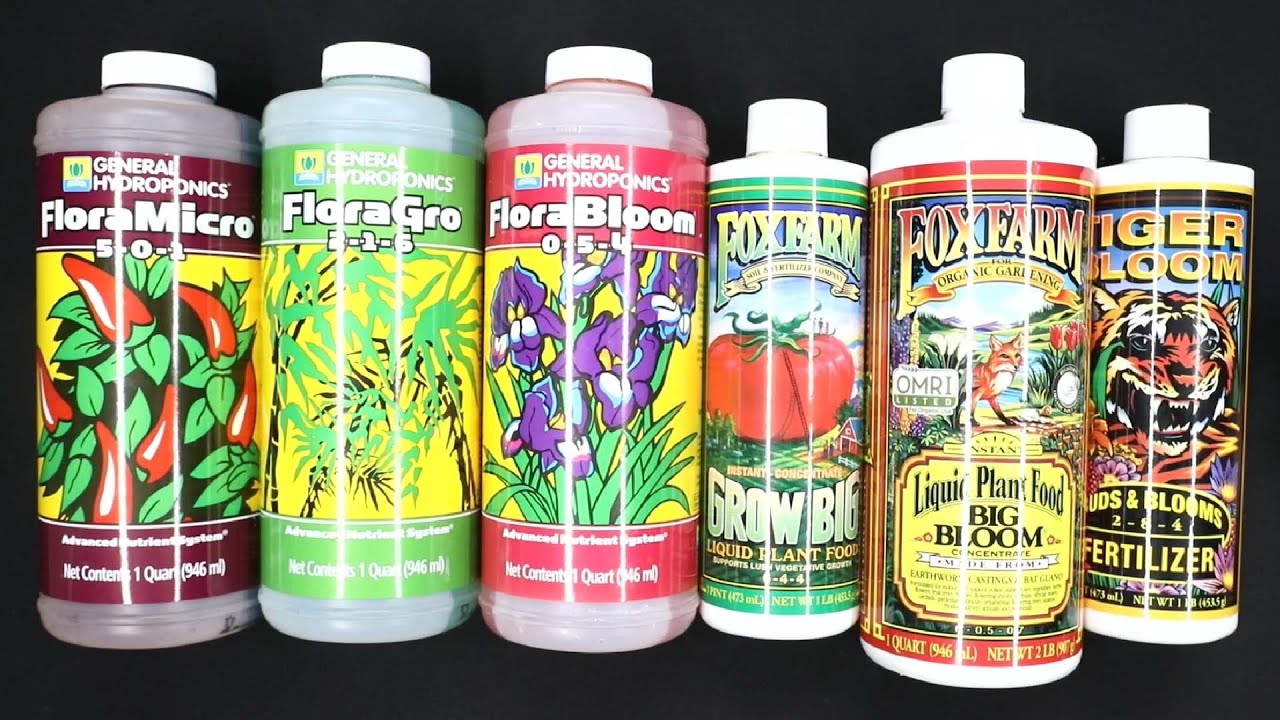
The useful part of this video is seeing the bottles, their roles and the practical differences I noticed while using them. Use the chapters to jump directly to a product. Read the current-label notes below before making a feeding decision.
Current-label comparison
Swipe or use the arrow keys to see all columns.
| Product | Current guaranteed analysis | Its job in the line |
|---|---|---|
| FloraMicro | 5-0-1 | FloraSeries foundation with nitrogen, calcium and micronutrients |
| FloraGro | 2-1-6 | Supports vegetative structure and supplies additional potassium |
| FloraBloom | 0-5-4 | Supplies phosphorus, potassium, magnesium and sulfur for flowering and fruiting |
| FoxFarm Big Bloom | 0-0.5-0.7 | Low-analysis earthworm-casting and bat-guano liquid used across growth stages |
| FoxFarm Grow Big, soil formula | 6-4-4 | Concentrated vegetative fertilizer for soil-based growing |
| FoxFarm Tiger Bloom | 2-8-4 | Acidic flowering fertilizer introduced at the first signs of bloom |
Do not add the three numbers in a row and call the result an ideal plant ratio. Guaranteed-analysis percentages describe each bottle, while a finished solution depends on the volume of each component, the water, the medium and the current program. The 2-5-3 target in the video was my shorthand at the time.
How General Hydroponics FloraSeries works
FloraSeries is designed as a three-part mineral system. General Hydroponics changes the final nutrient profile by changing how much Micro, Gro and Bloom are used together. The current three-part program directs growers to add FloraMicro first, FloraGro second and FloraBloom third, mixing thoroughly after each addition. Never mix the concentrates together.
In the video I call FloraMicro the foundation and FloraGro useless. General Hydroponics still uses FloraGro as a core vegetative component in its current program. You may choose a custom recipe in an advanced workflow. Check the current FloraSeries three-part program.
How the FoxFarm Soil Liquid Trio works
The FoxFarm soil trio is less visually symmetrical because the bottles do different kinds of work. Grow Big 6-4-4 is the main vegetative concentrate. Tiger Bloom 2-8-4 is the acidic flowering concentrate. Big Bloom 0-0.5-0.7 is a low-analysis liquid made from earthworm castings and bat guano that FoxFarm currently recommends across the growth cycle.
In the video I say Big Bloom is useless and will clog soil or pumps, and I stand by the clogging. I find it super silty, so I do not recommend it for hydroponic mediums. I also disliked the bottle volume and workflow. FoxFarm currently says Big Bloom can be used through drip irrigation and a no-clog applicator, so if you run it that way, shake it, keep it mixed and inspect your equipment. Read the current Big Bloom directions.
Which trio fits your grow?
Swipe or use the arrow keys to see all columns.
| If this sounds like you | Better starting fit | Why |
|---|---|---|
| You want one mineral line whose ratios can be adjusted across stages | FloraSeries | All three components form one measured program |
| You are growing in a soil mix and want FoxFarm’s labeled soil workflow | FoxFarm Soil Liquid Trio | Grow Big and Tiger Bloom provide the concentrated stage-specific nutrition, with Big Bloom in the broader program |
| You use small emitters or a recirculating reservoir | Favor a mineral workflow, then verify compatibility | Suspended organic materials require more attention to agitation and plumbing |
| You will not measure or record the finished mix | Neither line fixes that problem | A bottle cannot replace current directions, calibration and observation |
Cal-Mag, Epsom salt and silica are not automatic
Whether you need extra calcium or magnesium depends on the complete formula, source water, medium, cultivar, plant stage and actual symptoms. Check your water utility’s latest quality report, then measure the water you actually use.
Do not add Cal-Mag, Epsom salt or silica simply because another grower does. Each addition changes the final EC and nutrient balance. Start with the complete current program, monitor the plant and use the nutrient-deficiency guide as a diagnostic framework—not a shopping list.
How to start either program
- Name the exact medium. Charged soil, inert coco and hydroponic reservoirs do not begin at the same baseline.
- Use the current official chart. Old downloads, screenshots and bottle labels may not match today’s formulation.
- Measure source water. Record temperature, pH and EC before adding anything.
- Add one concentrate at a time. Follow the brand’s order and mix thoroughly between products.
- Measure the complete solution. Use a pH and EC meter. EC is universal; if you record PPM, name the meter’s conversion scale.
- Adjust pH last. Let the full mix stabilize before making small, diluted corrections.
- Start conservatively. A current chart is a starting framework, not permission to ignore a small or stressed plant.
- Track trends. Compare inputs, consistent runoff or reservoir behavior and new growth before changing several variables.
The nutrient mixing-order guide shows the sequence. Use the pH, EC and PPM guide and the fabric-pot feeding guide to interpret the finished mix and root-zone trend.
My verdict
I prefer the control and cleaner mixing workflow of FloraSeries for a measured mineral program. I do not recommend the FoxFarm trio. Tiger Bloom’s 2-8-4 NPK is just a bad balance, and Big Bloom is too silty for me to trust around pumps.
The best line is the one you can use consistently, measure correctly and adjust from evidence. Switching brands will not repair an inaccurate meter, a saturated root zone or a copied schedule that does not fit your medium.
Next in your grow
Before this step: How to Transplant Cannabis Without Shock
Next step: Cannabis pH, EC, PPM & Runoff: Complete Guide
Related: How to Water and Feed Cannabis in Fabric Pots · FoxFarm Tiger Bloom Review: pH & EC Test Results · TPS Nutrients – Complete Kit Review
Further reading: Penn State Extension: essential nutrients, deficiency and excess · Oklahoma State University Extension: EC and pH guide for hydroponics
Go deeper (supporter membership required): These advanced guides are for HWGrow supporters: Grow With Me – Day 29-41 – Blending Juices, Dunks, Responsive Feeding & Reading Leaves, LST. Become a supporter.
Recommended nutrient and measurement supplies
 General Hydroponics FloraSeries trioA three-part mineral line for changing the nutrient profile across growth stages. Follow the current Micro–Gro–Bloom mixing order.View product
 FoxFarm Soil Liquid TrioThe soil-program trio compared here. Verify the soil formula, current labels and official chart before mixing.View product
 pH and EC meter kitMeasure source water and the complete recipe. Calibrate the probes and record EC or the named PPM scale.View product
Affiliate disclosure: HWGrow may earn a commission from qualifying purchases at no additional cost to you. Product destinations can be replaced with equivalent current items without changing the comparison method.
Want a complete guided feeding workflow?
This public article explains how to compare two product lines without copying a recipe blindly. The Grow With Me Masterclass connects mixing, irrigation, runoff and plant response inside the complete grow without reproducing its protected lessons here. If your setup does not match either example, ask HWGrow a question and include the medium, source water, full recipe, dose, plant stage, input pH/EC and recent root-zone trend.
General Hydroponics vs. FoxFarm FAQ
Is General Hydroponics better than FoxFarm?
For a measured mineral program, I think so. FloraSeries gives you a three-part mineral workflow with adjustable ratios, and I do not recommend the FoxFarm trio.
Is FloraGro useless?
I call it useless in the video. General Hydroponics still uses FloraGro as a foundational vegetative component in its current three-part program.
Does Big Bloom clog pumps?
In my experience, yes. I find it super silty, and I do not recommend it for hydroponic mediums. FoxFarm currently lists it for drip irrigation and a no-clog applicator, so check your exact reservoir, pump and emitter if you use it.
Do I automatically need Cal-Mag with either line?
No. The need depends on the complete program, source water, medium, plant stage and what the plant shows. Measure first and avoid stacking supplements by habit.
Can I use your older feed charts?
Use the current official manufacturer chart as your starting point. My older charts may reflect previous labels or a specific setup, and protected Masterclass formulas are not reproduced here.
Growing in soil? Follow the full step-by-step guide to growing weed at home, and keep the interactive grow cheat sheet open on your phone for every week’s settings and how-to videos.
Comments
Leave a reply
You may also like
PRO-MIX HP Review: What the Lab Test Actually Says
pH vs. PPM for Cannabis: EC Scales, Buffering and Nutrient Lockout






Featured Grow

Shared a GIF.
One BB was entirely too short and compact, and another's spacing made it a bit too tall for me. On…
what were the reasons for the pulls?

we fight for every inch of canopy space we can get!

Is better to grow in supersoil rather than general hydroponics?
Do you happen to have any test tutorials for growing an auto flower in happy frog? Whilst using the fox farms trio and cal mag?
https://www.howweedgrow.com/hydro-vs-soil-weed-cannabis-grow/
The soil was happy frog using Fox Farms though, I would imagine the General hydroponics would be better in terms of P values, but the structure of the plant would probably be the same, small and poor yields.
I use 2 cubic feet of Happy Frog mixed with 2 bricks of coco coir and a small bag of perlite. I use GH Flora Trio (not fox farm) at 1/2 manufacture’s recommended amounts. At the beginning of flower and maybe 1 or 2 times during I hit it with a little Recharge. In a 2x2x4 tent with a 200w Q-Board in 5 gal fabric pots I consistently get 4-5 oz per grow (1 auto plant)
is there charts for autoflowers?
Yes but they’re paywalled Join Now