

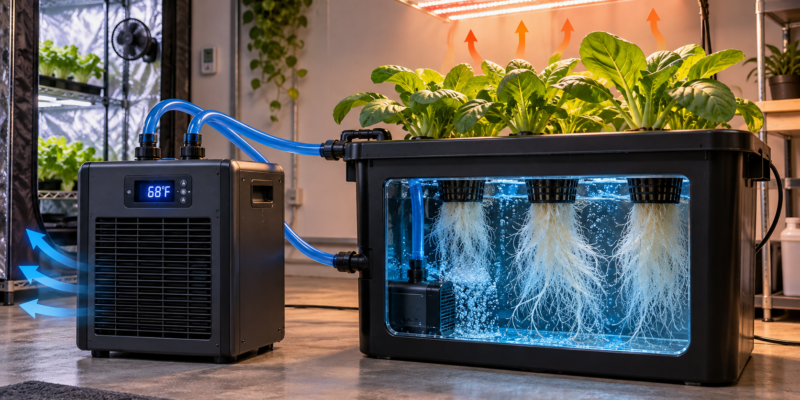
Hydroponic Water Chillers: Stop Summer Root Rot Before It Starts

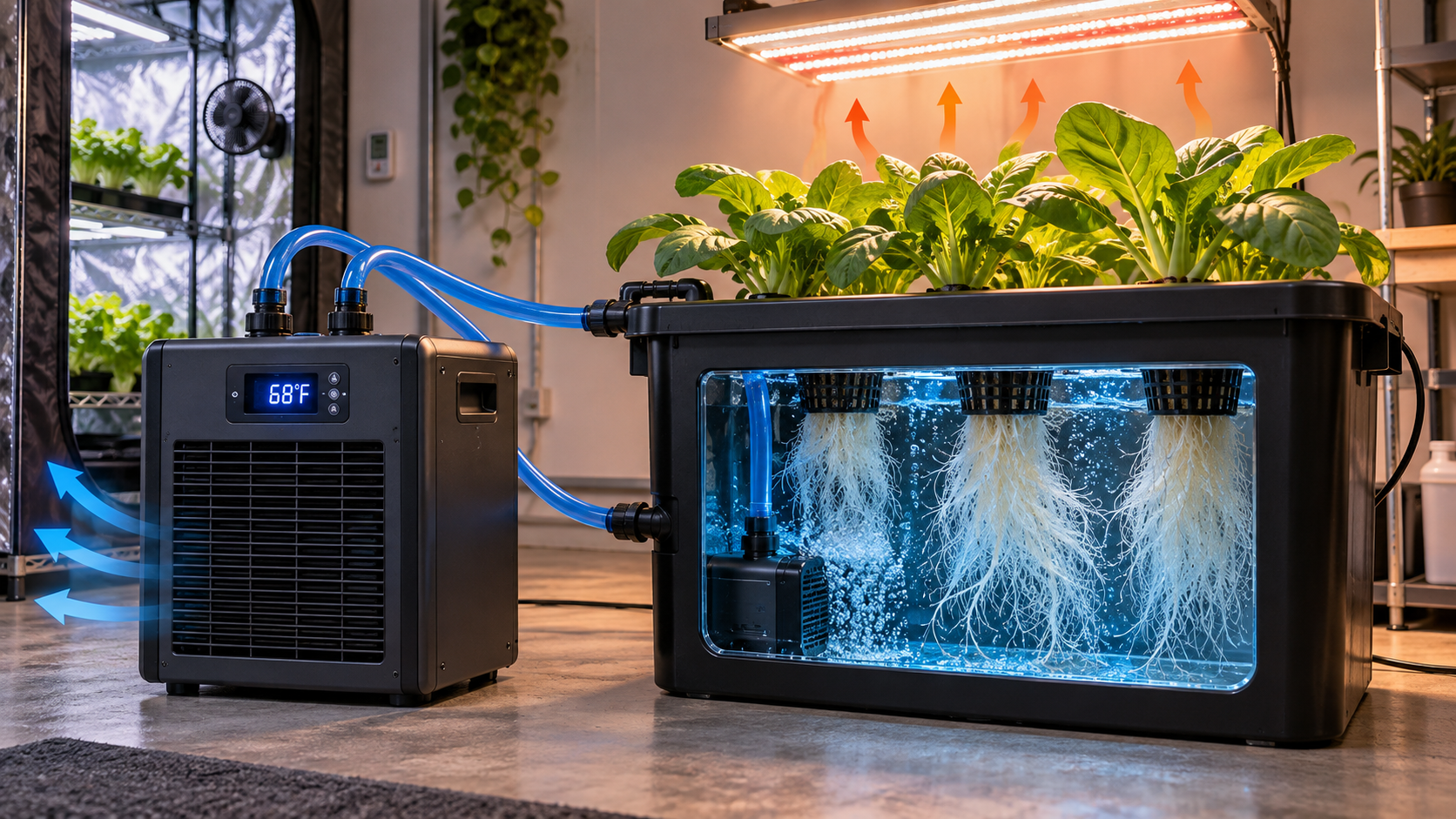
Quick answer: If your hydro reservoir spends the summer above about 75°F, stop treating a water chiller like a luxury. Warm nutrient solution holds less dissolved oxygen, the root ball uses oxygen faster, and waterborne root pathogens get a friendlier environment. For rooms that already run above 70°F—especially once a grow light adds roughly 10°F in a real tent—a thermostat-controlled chiller can be the cleanest way to keep the root zone stable.
Why warm water becomes a root problem
Cold water can hold more dissolved oxygen than warm water. The U.S. Geological Survey and EPA both explain that dissolved oxygen falls as water temperature rises. Roots, beneficial microbes and unwanted microbes are all competing for that oxygen.
Seventy-five degrees is not a magic switch that creates Pythium. It is a practical warning line. A controlled spinach hydroponic study found more severe Pythium root rot at higher solution temperatures, and Colorado State University Extension recommends maintaining nutrient solution around 68–72°F as part of root-disease management.
Water flow matters like airflow
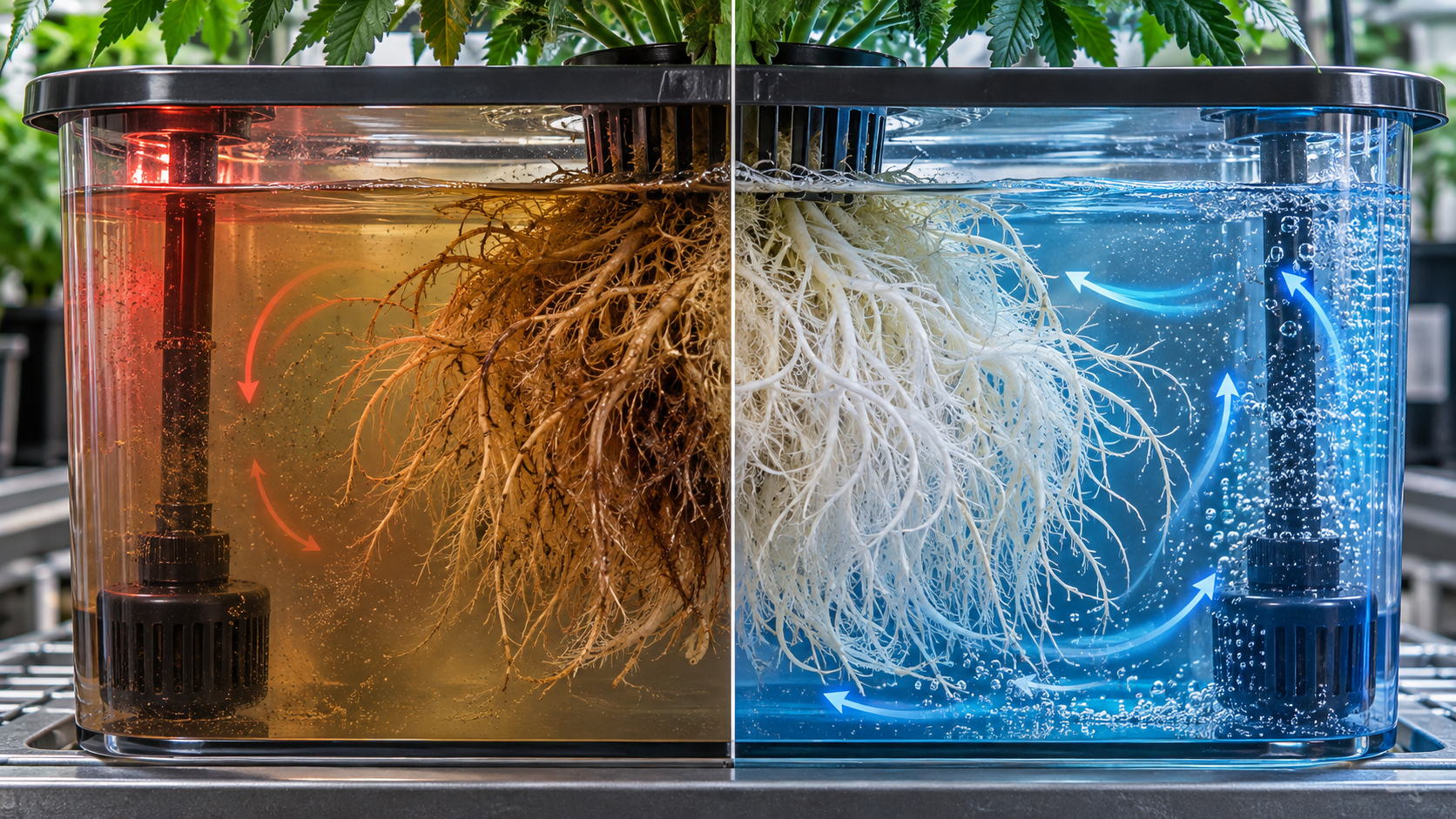
You can have a powerful air pump and still leave a warm, oxygen-poor heart inside a large root ball. Water has to move through the system, not just around the outside of the roots.
Warm water, old water, a dense root-ball center and weak circulation make a fun house for bacterial growth. Keep the return positioned so it turns the reservoir over instead of making one short path from outlet to inlet. Clean dead roots and sludge before they become food for the next problem.
Choose one biological strategy and run it correctly
Temperature and flow are the foundation. After that, hydro growers usually choose one of two very different approaches:
- Beneficial-microbe approach: compatible inoculants may include strains of Bacillus amyloliquefaciens. The exact strain, formulation and label matter; the species name alone does not prove a product will control every pathogen.
- Sterile/oxidizing approach: a carefully managed hydrogen-peroxide or other labeled oxidizer program suppresses microbes by design.
How to size a water chiller
A “79-gallon” chiller may be reasonable for a home system, but the marketing gallon number is only a starting point. The real job depends on:
Buy enough capacity that the compressor can cycle off. A severely undersized chiller can run constantly, warm the lung room and wear itself out while never reaching the setpoint.
What to look for before buying
- Digital thermostat with a clear setpoint and a readable actual-water temperature.
- Aquarium or saltwater-fish duty: those machines are built around keeping living systems stable.
- Published flow range: match the pump to the chiller instead of forcing water through too slowly or too quickly.
- Replaceable fittings and known hose size: avoid a machine that requires mystery adapters.
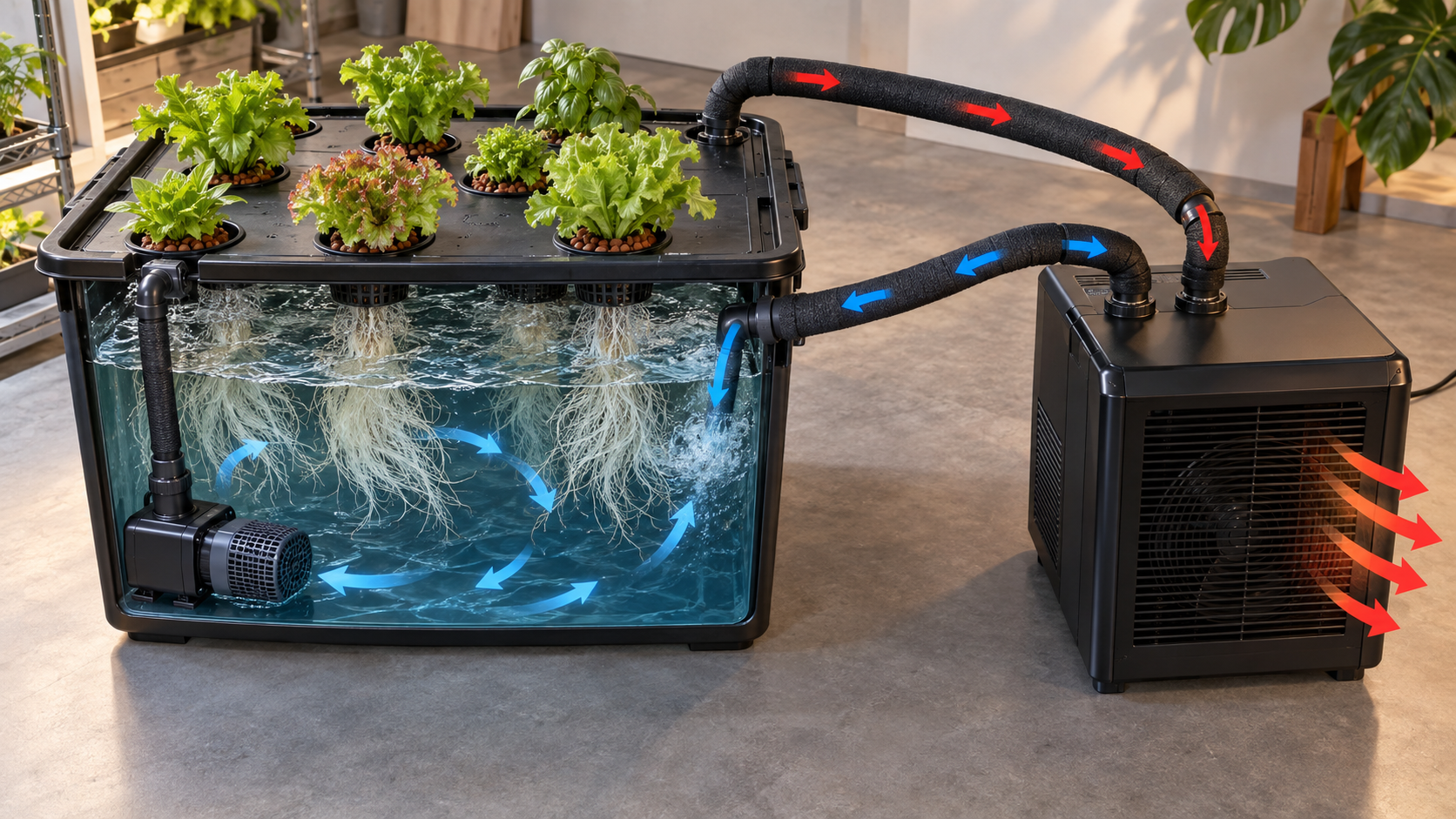
- Ventilation around the condenser: the heat removed from the water has to go somewhere.
- Serviceable filter or intake screen: roots and debris should not enter the heat exchanger.
- Warranty and refrigerant service path: especially important for a used machine.
The used cold-plunge hack
Cold plunges became a giant home-fitness fad, so used chillers now appear on Facebook Marketplace and other local resale sites. A cold-plunge chiller and an aquarium chiller solve the same basic problem: pump water through a heat exchanger and hold a set temperature.
That does not make every used unit a bargain. Ask what fluid was used, inspect for corrosion and leaks, verify the thermostat with a second thermometer, confirm the fittings, and run it with plain water before connecting it to living roots. A machine that kept fish alive is a useful benchmark because temperature stability and water compatibility matter—but sanitize any used system before it touches your reservoir.
Two current starting points
These are not endorsements of unknown sellers. They are examples in the right category. Confirm current capacity, voltage, fittings, pump requirements, warranty and exact ASIN before checkout.
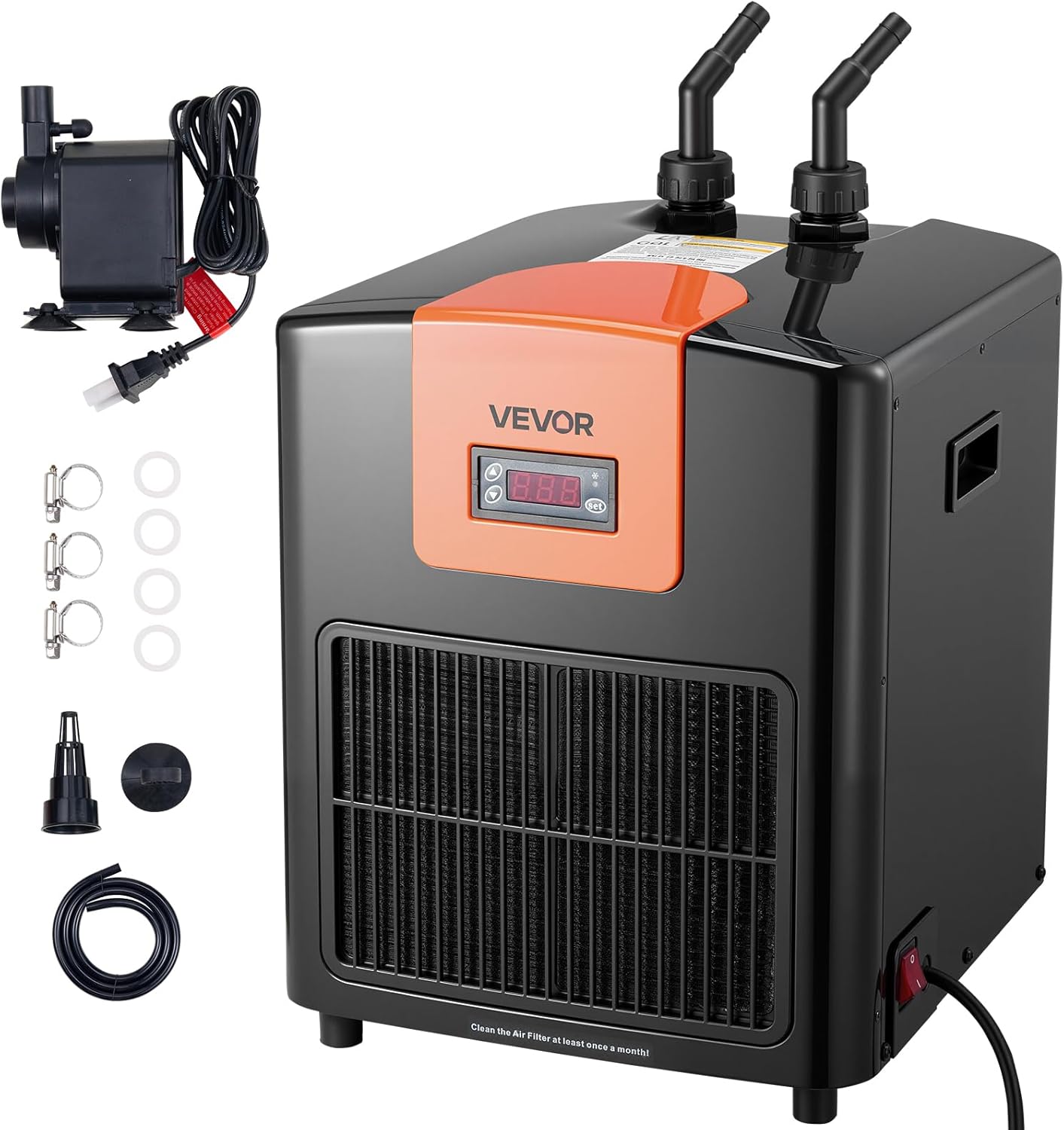 VEVOR 110-gallon / ⅓-HP water chillerA compressor chiller with digital temperature control for aquariums and hydroponic reservoirs. Verify the current fittings and pump-flow requirements for ASIN B0FHFQVP6B.
 Fitnet 79-gallon / ⅓-HP water chillerA compressor chiller with a touch-screen temperature controller for aquariums and hydroponic systems. Verify the current fittings and pump-flow requirements for ASIN B0GTTL2LWD.
Affiliate disclosure: HWGrow may earn a commission from qualifying purchases at no extra cost to you. Product listings, generations and sellers can change; verify the exact model and current specifications.
Do not forget the room
A chiller removes heat from water and releases it into the air. If the machine sits in a sealed hot tent, you are moving heat in a circle. Put it where its condenser can breathe, insulate long reservoir lines, and manage the lung room with the dehumidifier guide and airflow guide.
Sources
- U.S. Geological Survey: Dissolved Oxygen and Water
- U.S. EPA: Dissolved Oxygen
- Colorado State University Extension: Root Diseases in Hydroponic Systems
- Phytopathology: Temperature and Pythium Root Rot in Hydroponic Spinach
- Canadian Journal of Plant Pathology: Root and Crown Pathogens in Hydroponic Cannabis
You may also like

How to Breed Masterclass – Promo Video

How to Recycle Soil Organically: Re-Amend Used Potting Soil




Featured Grow

Looking healthy
Shared a GIF.
kind of looks a little too dry for my liking
of course you will

Growing the Purple Berry's now, hope I do her justice.