


Best Grow Tent Humidifier: Features That Actually Matter

Quick answer: the best grow tent humidifier is easy to refill, easy to clean, large enough to last through your lights-off period, and able to hold a target without spraying the plants. I still prefer a dark, top-fill reservoir with a sleep mode and adjustable output. Warm mist is optional—not automatically better—and the built-in humidity reading should always be checked against a separate canopy-height sensor.
It matters most for seedlings and fresh clones, which cannot yet replace the water dry air pulls from their leaves. Start them humid, then lower the humidity in steps as roots and leaves develop.
Why seedlings and clones need more humidity
A humidifier earns its place mostly at the start of a grow. Plants pull water up from the roots and lose it through tiny leaf openings called stomata—that loss is transpiration. A rooted plant can replace what it loses. A fresh cutting has leaves but no working roots yet, and a seedling has only a small root system, so dry air can pull water out of their leaves faster than they can replace it.
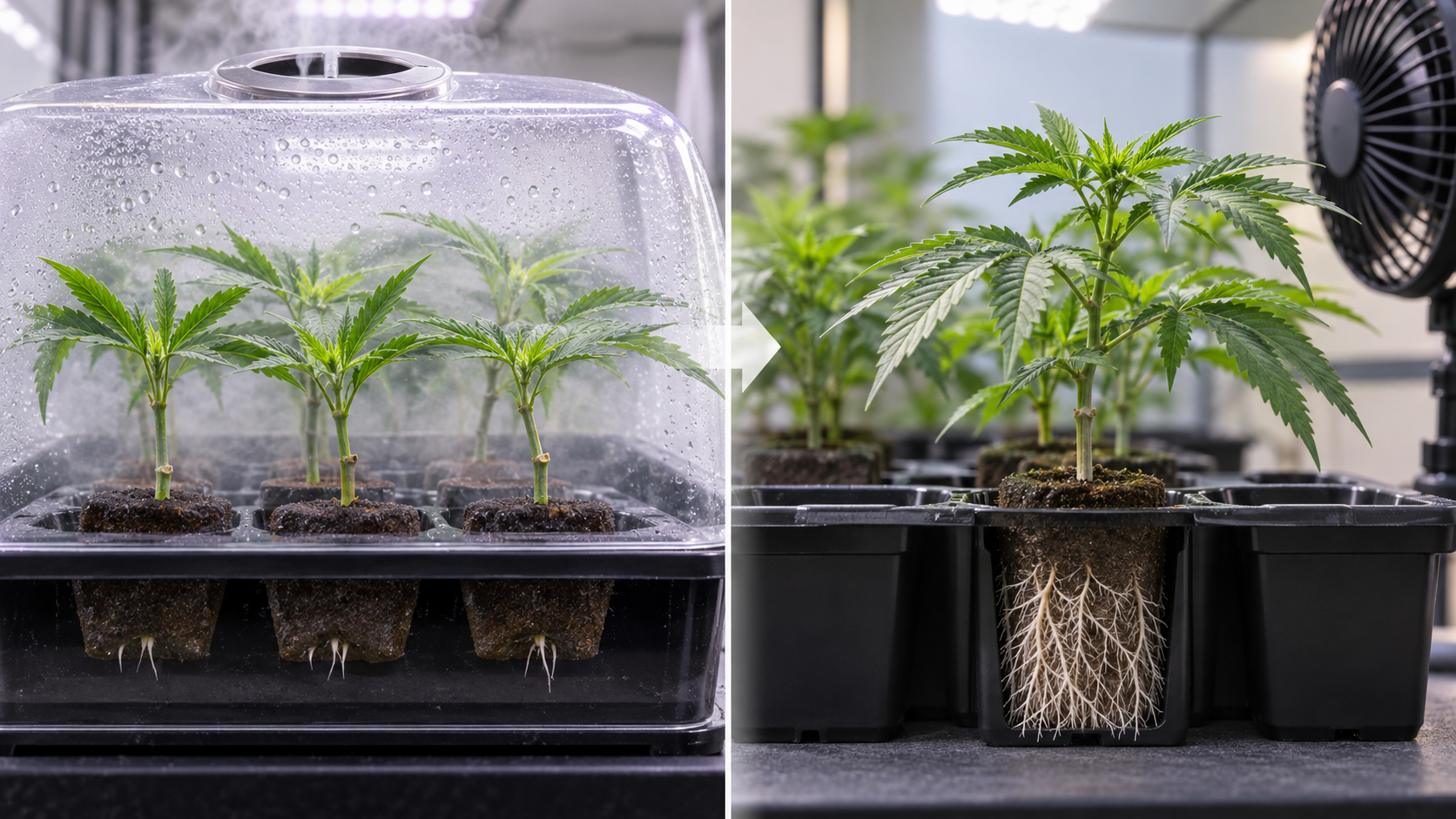
Higher relative humidity slows that water loss while roots form, which is why propagation guidance from the University of Florida and UMass Extension focuses on keeping unrooted cuttings from drying out. For the plain-language science, read why cannabis leaves sweat.
Step humidity down as the plant grows
I do not use one rigid number for every room—leaf temperature, airflow, rooting, irrigation and sensor error all matter. Treat these as starting ranges, then watch the plants:
| Stage | Starting RH range | What you are preventing |
|---|---|---|
| Fresh cuttings | About 75–85% | Leaf water loss before roots form. Use a dome or propagation space and still exchange the air. |
| Rooted clones and seedlings | About 65–75% | A sudden dry-air shock while the root system is small. |
| Established veg | About 55–70% | A room so wet the plant never adapts to normal airflow. |
| Flower | About 45–55%, often lower late | Condensation and trapped moisture inside dense flowers. |
Do not move a fresh clone from a humid dome straight into a dry tent. Open the vents, increase air exchange and lower humidity over several days while checking for droop. High humidity is a temporary tool, not a permanent target: once the plant can supply its own leaves, start moving toward the next stage’s range. The temperature and humidity guide covers the full-season targets.
Watch the original humidifier comparison
I bought several highly rated humidifiers before I knew which details mattered inside a grow. The useful lesson was not the logo on the front. It was what became annoying after months of filling, cleaning and running the machine around plants: clear tanks grew visible buildup, bottom-fill tanks were clumsy, small reservoirs ran dry, bright displays leaked light and hot mist could not be aimed carelessly.
- 0:00 — What years of use taught me
- 0:24 — Why clear tanks need extra attention
- 1:07 — Top-fill versus bottom-fill tanks
- 1:40 — Warm and cool mist options
- 2:14 — The two finalists
- 2:58 — Target humidity controls
- 3:24 — Hot-mist placement warning
- 3:37 — Lights-off sleep mode
The seven features I would shop for now
| Feature | Why it matters in a grow | What to avoid |
|---|---|---|
| Top-fill tank | Refilling is faster and less likely to spill water around cords and equipment. | A tank that must be flipped over every day unless the rest of the design is exceptional. |
| Opaque or dark reservoir | Blocks light that can encourage visible growth in standing water. | Treating a dark tank as self-cleaning. It still needs to be emptied and scrubbed. |
| Wide cleaning access | Your hand or brush should reach the wet surfaces where film forms. | Decorative tanks with narrow pockets you cannot inspect or dry. |
| Enough capacity | The tank should cover the longest unattended period without running dry. | Buying by room-size marketing without checking output and runtime. |
| Adjustable output | Prevents wet leaves and condensation when the room only needs a small correction. | A single full-power setting aimed at the canopy. |
| Target control | A humidistat can cycle the unit instead of running continuously. | Trusting the sensor beside the mist outlet without comparing it to canopy RH. |
| Dark or sleep mode | Turns off unnecessary display lighting during the plant’s dark period. | Taping over vents or safety openings to hide a bright display. |
Warm mist is an option, not a requirement
In the video I treat warm-and-cool mist as the better setup because warm mist can add a little heat during winter. That is useful in a cold room, but it is not free heat. Warm mist uses more energy, changes the room’s heat load and can damage nearby leaves if the outlet is too close.
If the grow is already warm, a cool-mist unit is usually the simpler choice. If you use warm mist, keep the outlet away from foliage, tent fabric and anything that can be damaged by heat or condensation. Measure the result at canopy height instead of deciding by feel.
Cool-mist ultrasonic and evaporative units add little practical heat; evaporation can even cool the air right around the mist slightly. A warm-mist or steam unit heats water on purpose and can raise the tent temperature. A compressor dehumidifier is the opposite case: it releases heat by design, which is why I keep a full-size one in the lung room. If the tent is too humid rather than too dry, see the grow-tent dehumidifier guide.
Put the sensor where the plant lives
The humidifier’s built-in sensor sits close to the machine and its own plume. That reading may not match the air inside a dense canopy. Place an independent thermometer/hygrometer near canopy height without letting mist hit it directly. Compare that reading with the room outside the tent and check the overnight high and low.
The goal is not to chase one perfect number every minute. Use the cannabis temperature and humidity guide to set a sensible stage range, then watch plant response, leaf temperature, irrigation rate and condensation together. Exhaust also matters: a humidifier cannot hold a stable target when the inline fan instantly replaces all of the treated air. The grow-tent ventilation guide explains that side of the system.
Clean water does not mean a clean humidifier
Visible algae was the problem that pushed me toward dark reservoirs, but an opaque tank only removes light from the equation. Standing water can still grow a film you cannot see. The EPA’s current humidifier care guidance says ultrasonic and impeller units can disperse minerals and microorganisms from their tanks into the air.
- Empty the tank and wipe wet surfaces dry every day when practical.
- Clean on the manufacturer’s schedule; the EPA recommends cleaning portable units at least every third day.
- Use distilled or other low-mineral water when the exact manual allows it, especially if ultrasonic mist leaves white dust.
- Rinse cleaning products completely before the unit returns to the tent.
- Do not add essential oils, nutrients or unapproved additives to the tank.
- Stop using a unit that has slime, an odor, a damaged cord or a leak near electrical equipment.
The CDC similarly recommends emptying portable humidifiers daily, cleaning them regularly and letting them air-dry. If you are deciding whether tap, distilled or reverse-osmosis water fits the equipment, start with your unit’s manual and the HWGrow water-quality guide.
Where should the humidifier go?
Inside the tent gives the fastest direct response, but it also takes up floor space and puts water beside lights, fans and cords. In a small tent I prefer placing the machine outside in the lung room when that room can be controlled. The intake and exhaust then move the conditioned air through the canopy.
If the humidifier must stay inside, set it on a stable waterproof surface, keep the outlet away from leaves and sensors, protect every plug from spills, and leave enough space to remove the tank without brushing the plant. Never put it where runoff can reach the cord or power strip.
A cool-mist unit is the safer choice for inside the tent because it adds so little heat. Whichever spot you choose, control it from a separate canopy-height sensor and turn it down before mist, condensation or wet leaves appear.
Current starting point
The 6-liter top-fill warm/cool-mist model has automatic humidity control and most of the practical features I look for. Check the seller, controls, cleaning access and return policy before buying.
 6L top-fill grow-room humidifierA current dark-reservoir starting point with adjustable warm/cool mist and target humidity control. Confirm the exact generation and cleaning access.View product
 Independent hygrometerCheck canopy and lung-room conditions instead of trusting the sensor built into one appliance.View product
 Seed tray and humidity domeProtect unrooted cuttings, then open the vents gradually as roots develop.View product
 Midea Cube dehumidifierFor an overly humid lung room. Use continuous drain and keep the compressor heat outside the tent.View product
Affiliate disclosure: HWGrow may earn a commission from qualifying purchases at no additional cost to you. Models and destinations can change; verify the exact specifications, seller and warranty before buying.
Next in your grow
Before this step: How to Set Up Grow-Tent Ventilation, Inline Fans and Carbon Filters
Next step: How to Light Cannabis and Choosing LED Grow Lights
Related: Cannabis Temperature and Humidity Guide · Best Grow Tent Dehumidifier: Why Mini Units Fail
Go deeper (supporter membership required): These advanced guides are for HWGrow supporters: Hydro Masterclass Case Study: Bud Rot Detection and Containment. Become a supporter.
Need help balancing the whole room?
Ask HWGrow and include the tent and room size, plant stage, day/night temperature and RH, exhaust setting, irrigation volume and the exact humidifier model. The Grow With Me Masterclass connects climate, watering and plant response without reproducing protected lessons here.
Grow tent humidifier FAQ
Is warm mist better for cannabis plants?
Not automatically. Warm mist can help a cold room, but it also adds heat and uses more energy. Cool mist is usually simpler when the grow is already warm.
Should a grow tent humidifier have a clear tank?
I prefer an opaque or dark tank because it blocks light, but tank color does not replace cleaning. Any reservoir with standing water can develop mineral scale or microorganisms.
Can I trust the humidifier’s built-in humidity sensor?
Use it for control, then verify it with a separate sensor at canopy height. The reading beside the machine and mist plume may not represent the air between leaves.
Can I use tap water in an ultrasonic humidifier?
Follow the exact manual. The EPA recommends low-mineral water such as distilled water to reduce scale and airborne mineral dust from ultrasonic or impeller units.
Should the humidifier go inside or outside the tent?
Either can work. Outside in the lung room is cleaner when that room can be controlled; inside responds directly but uses valuable space and puts water closer to electrical equipment.
What humidity do cannabis clones and seedlings need?
Fresh cuttings usually do best around 75–85% RH under a dome, and rooted clones and seedlings around 65–75%. Lower it over several days as roots develop instead of moving plants straight into dry air.
You may also like
PRO-MIX HP Review: What the Lab Test Actually Says
Complete Grow Tent Setup: Four Videos, One Working Setup





Featured Grow

Shared a GIF.
One BB was entirely too short and compact, and another's spacing made it a bit too tall for me. On…
what were the reasons for the pulls?

we fight for every inch of canopy space we can get!

Is better to grow in supersoil rather than general hydroponics?