

FoxFarm Tiger Bloom Review: pH & EC Test Results
Video chapters: Tiger Bloom pH and PPM test
- 0:00 — Tiger Bloom as a flowering formula
- 0:20 — Micronutrient and sulfur discussion
- 0:30 — Historical vegetative-use opinion
- 0:38 — Strong pH drop in the RO sample
- 0:44 — Label and lockout claim; corrected below
- 1:03 — Approximately 0 to 470 PPM
- 1:19 — NPK and potassium preference
- 1:29 — Label rate versus personal dose
- 1:48 — Original summary; evidence limits below

Last updated: August 2026
Quick answer: HWGrow tested 1 mL of FoxFarm Tiger Bloom 2-8-4 in 500 mL of reverse-osmosis water. That equals 2 mL/L, or about 7.6 mL per U.S. gallon. The video shows a strong downward pH response and reports a conductivity-based reading that moved from roughly 0 to 470 PPM. That tells you Tiger Bloom is concentrated and intentionally acidic. It does not prove the product will “surely” drive every soil into lockout or that 3–4 mL per gallon is the only correct dose.

Selecting a timestamp opens the video at that moment without moving you away from this section.
What is FoxFarm Tiger Bloom?
Tiger Bloom is the trio bottle whose name matches its job. It is a 2-8-4 flowering fertilizer with nitrogen and micronutrients. FoxFarm currently recommends introducing it at the first signs of flowering and continuing through harvest. The product is formulated at a low pH for storage stability and micronutrient availability, and FoxFarm lists it for both soil and hydroponic applications.
That last detail matters: low product pH is intentional, but the concentrate is not the final root-zone environment. FoxFarm’s current directions tell growers to raise the finished nutrient solution to a desired 5.8–6.3 and to use a conductivity or PPM meter in hydroponic systems. Read the current FoxFarm Tiger Bloom analysis and directions.

HWGrow Tiger Bloom test results
| Product tested | FoxFarm Tiger Bloom, 2-8-4 |
|---|---|
| Water | 500 mL reverse-osmosis water |
| Product dose | 1.00 mL |
| Equivalent rate | 2 mL/L, about 7.6 mL per U.S. gallon |
| pH result | Strong downward movement shown in the source video; the narration does not state the exact starting and final values |
| Initial conductivity-based PPM | Approximately zero in the source video |
| Reported final PPM | Approximately 470; the conversion scale was not stated |
| Historical extrapolation | About 62 PPM per additional mL/gallon if response were linear on the same meter scale; not independently mixed or verified |
This is the same standardized ratio used in the HWGrow nutrient-test protocol. It is a comparison screen, not a flowering feed schedule.
What the result really tells you
Tiger Bloom is intentionally acidic
The sharp drop in low-buffer RO water is consistent with FoxFarm’s explanation that Tiger Bloom is formulated at low pH for storage and micronutrient stability. RO water has little alkalinity, so it can move dramatically. Tap water, other nutrients and the growing medium can buffer or change the final result.
Feed-solution pH is not the same as soil pH
The old video jumps from a low mixed-solution reading to “this will surely drop your soil’s pH to unhealthy levels” and cause lockout. That is too certain. Root-zone pH depends on source-water alkalinity, medium buffering, fertilizer form, irrigation frequency, drainage, plant uptake and time. A low feed pH deserves measurement and adjustment—not a guaranteed lockout diagnosis.
The 470 PPM result needs a named scale
PPM meters usually convert electrical conductivity using a 500, 640 or 700 scale. The video did not name the scale, so “470 PPM” cannot be compared safely with a chart that uses another conversion. Record EC when possible. If you use PPM, write down the scale.
“Average” is not a test result
The conductivity increase is a real observation for that sample. Calling it average requires a defined comparison group tested under the same conditions. The video also estimates about 62 PPM for each additional mL per gallon by simple dilution math. That can be a rough planning estimate, but it is not a substitute for mixing and measuring the actual full recipe.
Correcting the old feeding conclusions
The video calls FoxFarm’s 10–15 mL-per-gallon direction laughable and presents 3–4 mL per gallon as the better dose. That was HWGrow’s historical personal program, not a universal result from this test.
- FoxFarm’s current general direction converts to about 9.8–14.8 mL per gallon every other watering.
- The tested 7.6 mL-per-gallon equivalent is below that current general range.
- The test measured one bottle in RO water, not a complete trio recipe in a planted container.
- A 2-8-4 analysis is a guaranteed nutrient ratio, not proof that the formula is good or bad for every flowering program.
- The absence of sulfur from a short product overview does not prove a sulfur deficiency will occur. Evaluate the complete recipe, medium and water.
- Adding Grow Big during flower is a program choice that changes the full NPK and EC; it should not be prescribed from this one-bottle screen.
The better rule: use the current label or a complete established program as a starting point, then measure the full solution and adjust to the plant, medium and repeatable root-zone trend.
How to use Tiger Bloom without guessing
- Confirm the bottle and stage. Tiger Bloom is 2-8-4 and is intended from the first signs of flowering through harvest.
- Check current directions. Retail and commercial labels may express rates differently; convert units carefully.
- Measure source water first. Record temperature, pH and EC. Search your ZIP code plus “water report” for local alkalinity and mineral data.
- Dilute one concentrate at a time. Add to water, mix thoroughly and never combine concentrates before dilution.
- Measure the complete recipe. Use EC when possible, or name the PPM scale.
- Adjust pH last. Let the complete solution stabilize, then follow the target appropriate to the medium and current label.
- Watch the root zone over time. Compare consistent input and runoff measurements instead of diagnosing lockout from one feed number.
- Respond to the plant. Stage, vigor, medium charge and irrigation history matter more than copying a maximum label rate or a historical personal rate.
For the rest of this evidence series, see the Grow Big 6-4-4 review and Big Bloom 0-0.5-0.7 review. Use the nutrient mixing-order guide and runoff testing guide for the complete measurement workflow.
Tiger Bloom test limitations
| What was controlled | What remains unknown |
|---|---|
| 1 mL dose in 500 mL RO water | Independent repeats, bottle variation and uncertainty |
| Strong pH movement was visible | Exact narrated values and response in buffered water or a full recipe |
| Conductivity-based display moved to about 470 PPM | Meter conversion scale and calibration standard |
| Linear per-gallon estimate can be calculated | Higher concentrations were not separately mixed and measured |
| Current label directions can be verified | No plant, soil, tissue, yield or deficiency trial was conducted |
Recommended Tiger Bloom and testing supplies
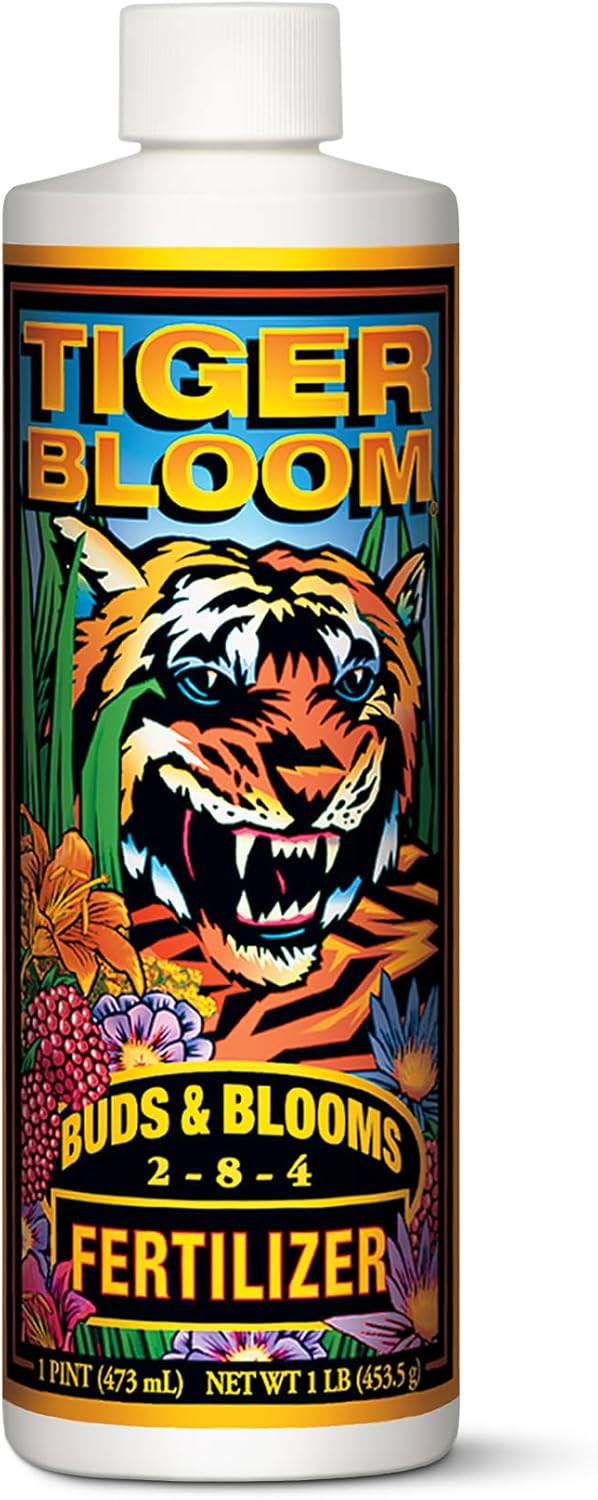 FoxFarm Tiger Bloom 2-8-4The acidic flowering concentrate tested here. Verify the current label and measure the complete diluted solution.View product
 FoxFarm Soil Liquid TrioTiger Bloom is normally one part of this soil program. Dilute each concentrate separately and measure the final combination.View product
 pH and EC meter kitTiger Bloom can move pH sharply in low-buffer water. Calibrate the probes and verify the complete mix before feeding.View product
Affiliate disclosure: HWGrow may earn a commission from qualifying purchases at no additional cost to you. Product destinations may be replaced with equivalent items; verify the exact formula and current label before use.
Want the full feeding workflow?
This page explains one controlled product screen. The Grow With Me Masterclass connects mixing, flowering feeds, runoff and plant response inside a guided workflow without reproducing protected lesson content here. If your numbers differ, ask HWGrow a question and include the bottle, lot, dose, source water, full recipe, temperature, pH, EC/PPM scale, medium and stage.
FoxFarm Tiger Bloom FAQ
Is Tiger Bloom for soil or hydroponics?
FoxFarm currently lists Tiger Bloom for both soil and hydroponic applications. Follow the current directions for the system you use.
Did HWGrow test 1 mL per gallon?
No. HWGrow tested 1 mL in 500 mL, equivalent to about 7.6 mL per gallon.
Will Tiger Bloom always cause soil lockout?
No. The concentrate is acidic and strongly lowered this RO-water sample, but soil/root-zone pH depends on the complete solution, source-water alkalinity, medium, irrigation and plant uptake over time.
Is 3–4 mL per gallon the correct Tiger Bloom dose?
That was a historical personal rate in the source video, not a universal result. FoxFarm’s current general directions are higher. Choose a complete program, measure the final solution and adjust to the plant and root-zone trend.
Does Tiger Bloom contain enough sulfur for cannabis?
This product screen did not measure sulfur or diagnose plants. Evaluate the complete fertilizer program, medium and water rather than deciding from the 2-8-4 headline alone.
You may also like
PRO-MIX HP Review: What the Lab Test Actually Says
pH vs. PPM for Cannabis: EC Scales, Buffering and Nutrient Lockout





Featured Grow

Mine wasnt that bad, i am low rate afib so just swing between 95 and high as 150 sometimes, up…

Yeah not fun, but as long as it helps thats what matters. Had my heartrate 200+bpm in the hospital for…
Tupac mine is for afib. Just Had cardio version the other week to get me out of it, worst case…
I was hoping for one at least that check the box's, but ya, having a couple is that much better.…
Heart cath ablation? Had one of those for Super Ventricular Tachycardia and it worked well