


How Many Times Should You Top Cannabis? Canopy Formula & Cut Guide

Last updated: September 2026
Quick answer: Do not pick a random number of topping rounds. Work backward from your canopy. Give every finished top about 4 square inches, calculate how many tops fit in the space, divide that number by your plant count, and round down to a practical power of two: 2, 4, 8, 16 or 32. Every complete round doubles the leaders, so one becomes two, two become four, four become eight and eight become sixteen.
A trellis is what turns that math into an organized canopy. Without one, a plant can make the right number of branches and still pile them on top of each other.
Watch: where to cut and how one top becomes two
This focused HWGrow clip removes the intro and stops before the older spacing shortcut. It shows the actual plant anatomy, the cut location and the branch-doubling pattern used in the formula below.
Selecting a timestamp opens the standard HWGrow pop-out at that exact moment without moving you away from your place in the article.
How to calculate how many times to top
Use this simple planning formula:
Topping calculator
Complete topping rounds7
Planned tops per plant128
Planned tops in the tent256
4-square-inch capacity288
- Start: 1
- Round 1: 2
- Round 2: 4
- Round 3: 8
- Round 4: 16
- Round 5: 32
- Round 6: 64
- Round 7: 128
For a 2 × 4 tent with 2 plants: seven complete rounds create 128 planned tops per plant, or 256 total, beneath the 288-top mathematical ceiling.
This is a spacing ceiling, not an order to keep cutting. Stop earlier when the plant needs recovery time, the trellis is already full or your available vegetative time is running out.
Total top capacity = usable canopy width in inches × usable canopy length in inches ÷ 4
Target tops per plant = total top capacity ÷ number of plants
Then round the per-plant number down to a practical power of two. Rounding down leaves room for airflow, access and uneven growth instead of forcing branches into a plan that only works on paper.
| Finished tops per plant | Complete topping rounds from one main tip |
|---|---|
| 2 | 1 round |
| 4 | 2 rounds |
| 8 | 3 rounds |
| 16 | 4 rounds |
| 32 | 5 rounds |
This assumes you top every active leader during each round. If you skip a branch, lose one or decide the canopy is already full, the final count will not be a perfect power of two—and that is fine. The plant does not care whether the spreadsheet looks symmetrical.
Example: four plants in a 2-by-2-foot canopy
A 24-by-24-inch canopy has 576 square inches. Divide by 4 square inches per finished top and the theoretical capacity is 144 tops. Divide by four plants and the result is 36 tops per plant. Round down to 32, which is five complete topping rounds from one main tip.
That is a planning ceiling, not a command to force five cuts onto every plant. Plant health, cultivar structure, available vegetative time and how evenly the trellis fills can make 16 tops per plant the better stopping point.
When should you top again?
Wait until the two new leaders are clearly growing and long enough to make the next cut without damaging the node below them. The plant in the video moves quickly and can be ready in roughly three days, but use the growth in front of you instead of treating three days as a deadline.
Do not top again while the plant is wilted, recently transplanted, overwatered, showing an unresolved deficiency, fighting pests or still stalled from the previous cut. A clean recovery is more important than keeping a calendar.
Where to make the topping cut
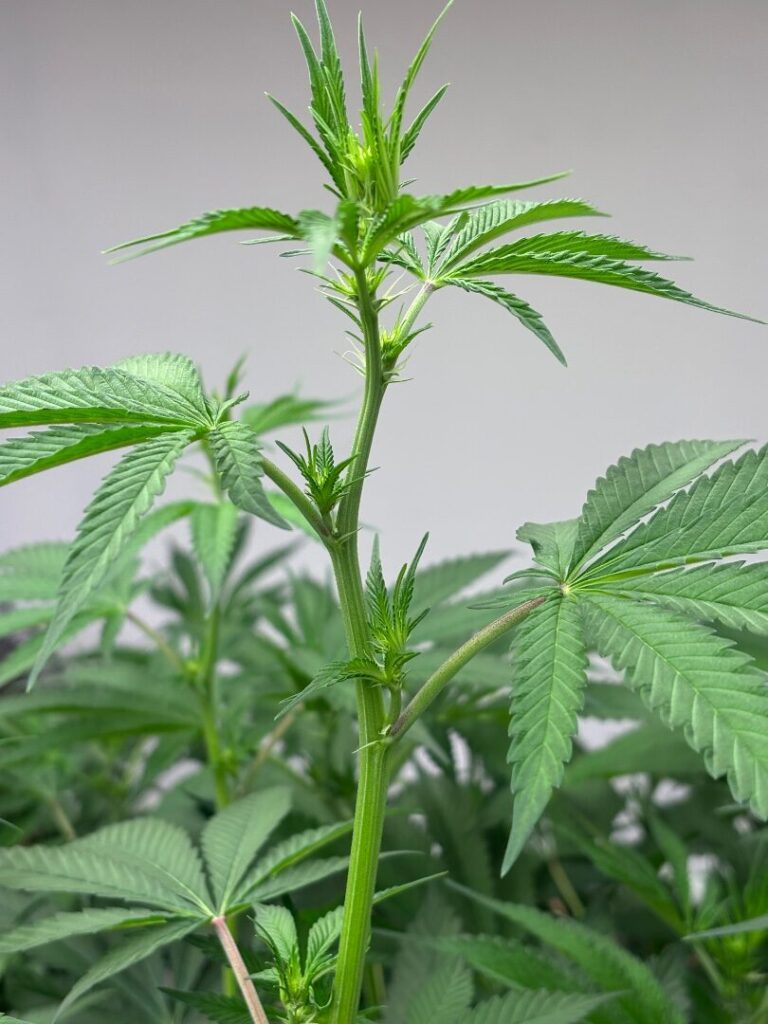
- Find the growing tip. This is the tight newest growth at the end of a main stem.
- Find the node below it. The two small shoots at that node are the future leaders.
- Remove the tip above the node. Make one clean cut and leave a small amount of stem instead of shaving the junction flush.
- Let the two branches take over. Once both are actively growing, guide them into separate sections of the trellis.
- Repeat only if the canopy math and plant health support it. More tops are useful only when you have space to separate and light them.
Why the trellis matters
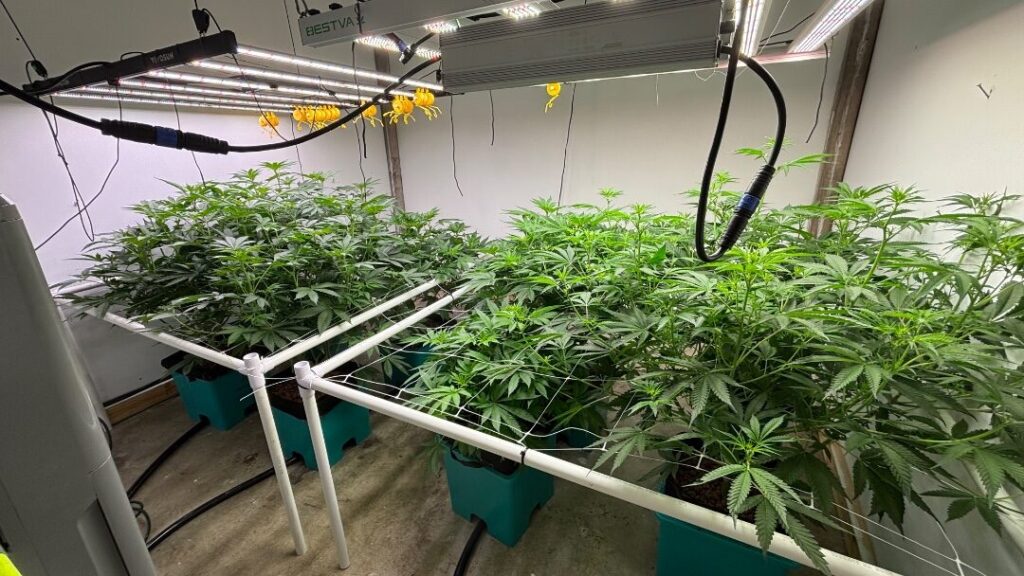
Topping creates more leaders; the trellis tells those leaders where to go. Place each top into its own section of the usable canopy so one branch does not shade another. As the plant grows, guide branches sideways under the net and let each tip rise into an open area.
If you need the full training workflow, see the separate topping, FIM, low-stress training and SCROG guide. It explains how to combine cuts with soft ties and a screen without stacking every stress on the same day.
Topping versus FIMming
A clean top removes the entire growing tip, so the two shoots below it become the predictable new leaders. A FIM removes only part of the newest growth and can create a less predictable cluster. If your goal is to use the 1-to-2-to-4-to-8 math, topping is the cleaner choice.
Common mistakes
- Choosing a number before measuring the canopy: the space and plant count should set the target.
- Counting tops without spreading them: use a trellis so each leader gets its own light and airflow.
- Topping a stalled plant: solve root-zone, pest, feed or environmental problems first.
- Cutting too close to the junction: leave a small stump so the split has support.
- Forcing another round because three days passed: wait for strong new growth.
- Chasing a yield promise: topping changes plant architecture; genetics, roots, light, climate and recovery still determine the result.
Recommended topping and canopy tools
 AC Infinity precision pruning shearsUse the straight stainless blades for a clean topping cut without crushing the growing tip.View product
 70% isopropyl alcoholClean the blades before the first cut and again before moving to another plant.View product
 AC Infinity 2 × 4 elastic trellisSpread the doubled leaders across the tent so each finished top keeps its own light and airflow space.View product
AC Infinity savings: Use code EVYGROWS for additional savings on eligible products. When shopping on Amazon, clip any available coupon first.
Affiliate disclosure: HWGrow may earn a commission from qualifying purchases at no additional cost to you. Equivalent clean tools can replace the linked products without changing the technique.
Want help planning the whole canopy?
The public guide gives you the calculation and cut. The protected Grow With Me Masterclass shows how plant training fits beside feeding, light, climate and the rest of a complete grow without reproducing those paid lessons here. If you want a second opinion before cutting, ask HWGrow a question and include your canopy dimensions, plant count, cultivar and a whole-plant photo.
Frequently asked questions
How many times should I top a cannabis plant?
Calculate the available tops from canopy area and plant count instead of using one fixed number. Allow about 4 square inches per finished top, divide by the number of plants and round down to a practical power of two.
How many tops does each round create?
If every leader is topped successfully, one becomes two, two become four, four become eight, eight become sixteen and sixteen become thirty-two.
Do I need a trellis after topping?
Yes for a planned multi-round canopy. The trellis spreads the growing leaders into their assigned space so they do not crowd and shade each other.
Can I top again after three days?
Sometimes, but three days is an example rather than a deadline. Wait until both new leaders are actively growing and long enough to cut cleanly.
Next: Watch how to install a trellis and spread the finished canopy
Growing in soil? Follow the full step-by-step guide to growing weed at home, and keep the interactive grow cheat sheet open on your phone for every week’s settings and how-to videos.
Comments
Leave a reply
You may also like
pH vs. PPM for Cannabis: EC Scales, Buffering and Nutrient Lockout
Complete Grow Tent Setup: Four Videos, One Working Setup






Featured Grow

Mine wasnt that bad, i am low rate afib so just swing between 95 and high as 150 sometimes, up…

Yeah not fun, but as long as it helps thats what matters. Had my heartrate 200+bpm in the hospital for…
Tupac mine is for afib. Just Had cardio version the other week to get me out of it, worst case…
I was hoping for one at least that check the box's, but ya, having a couple is that much better.…
Heart cath ablation? Had one of those for Super Ventricular Tachycardia and it worked well
Thank you so much for generously sharing your knowledge , it’s been very helpful!! . I have a question about topping, when is the best time to do it? Is it better to top in the morning when the plant “wakes up,” or at night before the dark period begins? Or does timing not make much of a difference?
Also, is there ever a point when it’s too late to top?
I top on the 4th node as lonmg as the plant is stable and has a strong main stem. Doesnt matter on time. if I had to pick, I would probably do it right when lights turn on because at night humidity spikes and that could open ideal conditions for mold