

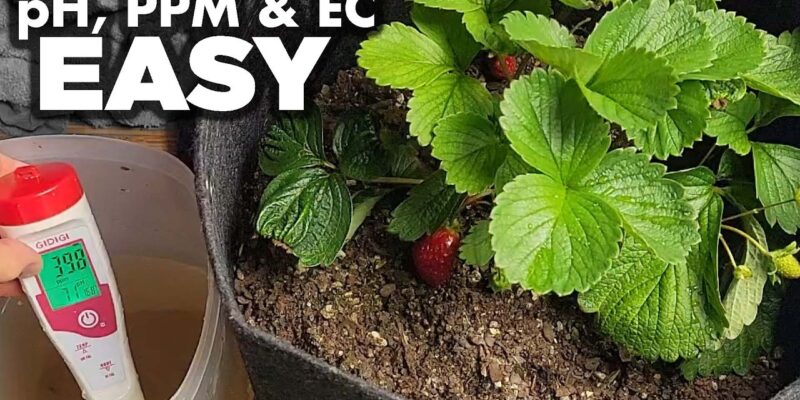
pH vs. PPM for Cannabis: EC Scales, Buffering and Nutrient Lockout

Quick answer: pH and PPM are not two versions of the same measurement. pH tells you how acidic or basic the root-zone solution is, and its scale is logarithmic. EC measures electrical conductivity from dissolved ions. A meter may convert EC to a PPM number using a fixed 500 or 700 scale, so that displayed conversion is linear.
Before you throw more nutrients at an ugly plant, stop. If the root-zone pH is wrong, the plant may have nutrients around it and still struggle to use them. Adding more fertilizer can turn one problem into two: the pH is still off and now the salt concentration is higher.
Video chapter guide
- 0:09 — Nutrient lockout from bad pH
- 0:33 — Useful pH range and nutrient availability
- 1:00 — What PPM measures and the two-cup nutrient test
- 2:12 — 500 vs. 700 PPM scales and EC
- 2:53 — How to identify your meter’s scale
- 3:28 — Why pH is logarithmic
- 4:08 — Equal pH-adjuster dose, different response
- 5:23 — Bagged-soil test and slurry demonstration
PPM is a display. EC is the measurement.
PPM means parts per million. A TDS meter does not identify every nutrient or count individual fertilizer molecules. It measures how well the solution conducts electricity, then estimates a PPM value from that EC reading. That is why one meter can show 500 PPM while another shows 700 PPM in the exact same 1.0 mS/cm solution.
The conversion is simple:
- 500 scale: PPM = EC × 500
- 700 scale: PPM = EC × 700
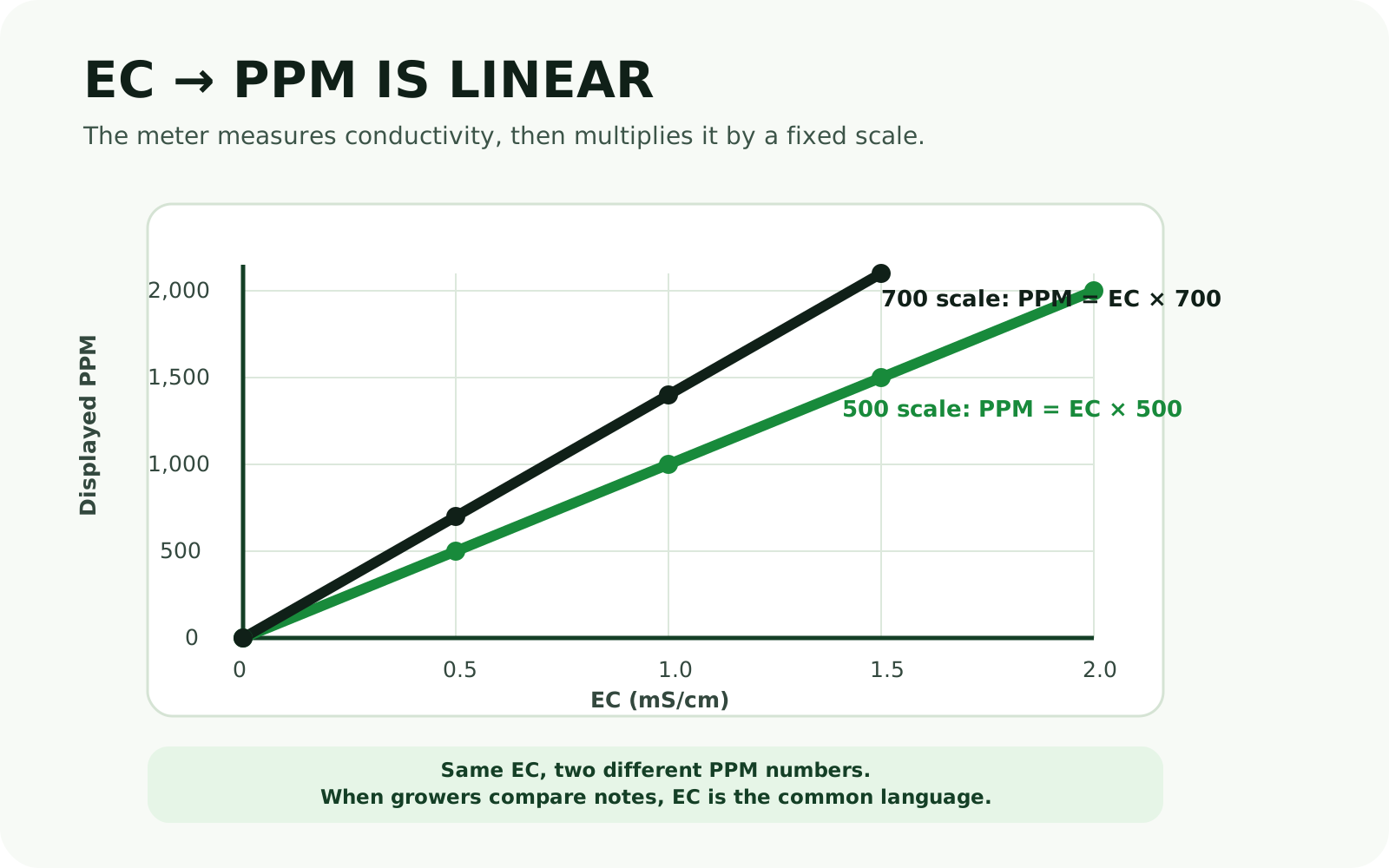
When growers compare feeds, use EC whenever possible. If you use PPM, always say which scale. Also remember that EC reports total conductivity, not the individual nutrient balance. Salt, tap-water minerals and fertilizer ions can all raise the number.
pH is logarithmic—one point is a tenfold change
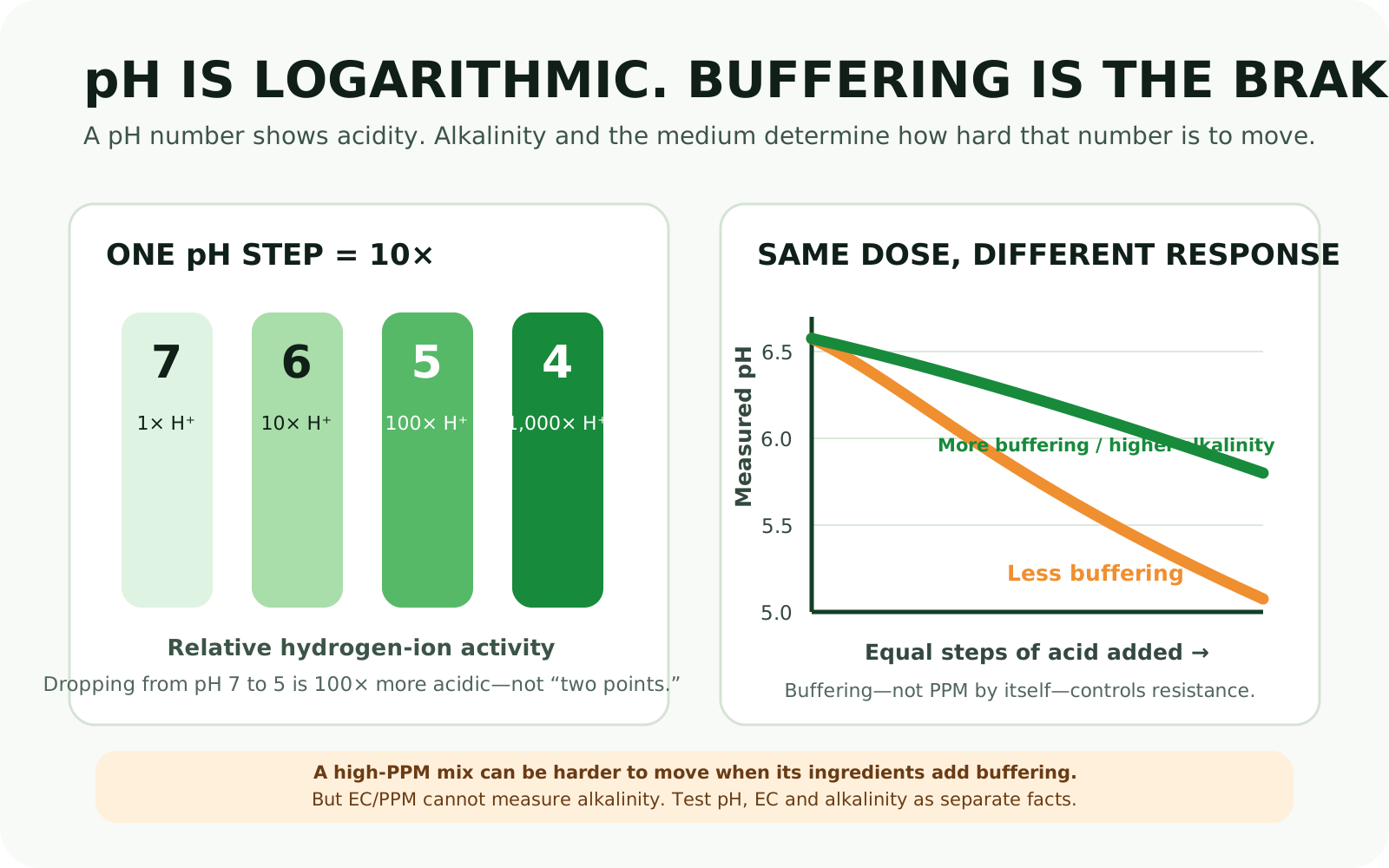
pH tracks hydrogen-ion activity. Moving from pH 7 to pH 6 is not a small one-unit slide; it represents about ten times greater hydrogen-ion activity. Moving from 7 to 5 is about 100 times. This is why you do not treat pH like a ruler and you do not make giant corrections because one runoff reading looks far away from a target.
Why the higher-PPM cup moved less in the video
In the experiment, both cups started near the same pH. The same dose of pH Up moved the lower-PPM cup farther. The clean explanation is that the two mixes did not have the same buffering capacity. More dissolved fertilizer can add bicarbonates, phosphates and other acid/base systems that resist change, so higher EC and stronger buffering sometimes travel together.
But correlation is not a meter function. EC cannot tell you alkalinity. Missouri Extension defines alkalinity as the water’s capacity to neutralize acids and notes that high-alkalinity water needs more acid to change pH. Two nutrient solutions can share the same EC and have different alkalinity, so treat pH, EC and alkalinity as separate facts.
pH problems can look like nutrient problems
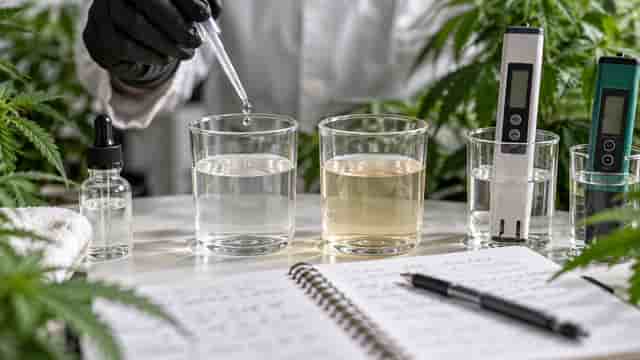
Root-zone pH changes nutrient solubility and availability. When the range is wrong for the medium and crop, adding more of the same fertilizer may not fix uptake. It can raise EC, increase osmotic stress and make the diagnosis harder. Measure first, then decide whether the problem is pH, excessive salts, an unbalanced recipe, bad watering, root damage or something else.
There is no honest universal PPM target for every cannabis plant. Stage, cultivar, water, fertilizer, soil, coco, hydro system and test method all change what the number means. Use the complete HWGrow pH, EC, PPM and runoff guide for current medium-specific starting ranges and the runoff testing guide for a repeatable collection method.
A safer measurement order
- Calibrate the meters. A precise-looking wrong number is still wrong.
- Measure source water. Record EC and check a water report for alkalinity when pH keeps drifting.
- Mix the complete feed. Add products in the correct order and stir between additions.
- Set EC first. Dilute or add nutrients only within the program for that crop and medium.
- Adjust pH last. Add tiny amounts, mix thoroughly, wait for stabilization and remeasure.
- Record the trend. One reading is a snapshot. Repeated measurements taken the same way tell the story.
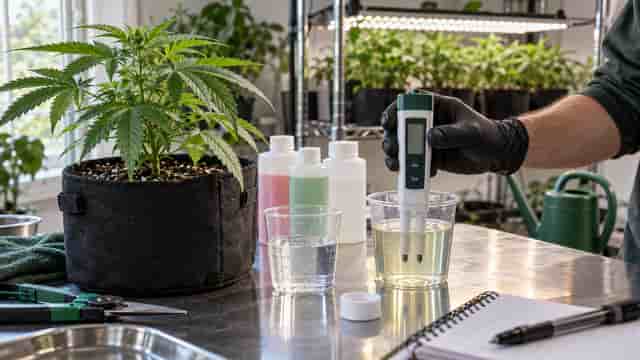
What the slurry test can—and cannot—tell you
A well-mixed soil slurry can help screen the root zone when you use equal parts medium and distilled water, allow it to equilibrate, and repeat the same method. It is much better than randomly pouring pH adjuster into a full pot because a leaf looks strange.
Do not blindly multiply a one-cup dose into a large bag of soil. pH is logarithmic, the medium is heterogeneous and amendments buffer differently. Use the cup as a diagnostic, make a modest correction that matches the product and medium instructions, mix completely, let it stabilize and retest. For a dedicated protocol, follow the HWGrow soil-slurry guide.
Frequently asked questions
Is EC the same as PPM?
No. EC is the conductivity measurement. PPM is a calculated display derived from EC, commonly using a 500 or 700 multiplier.
Why does a high-PPM solution sometimes need more pH Up or Down?
Because the ingredients may add alkalinity or other buffers. High PPM can accompany stronger buffering, but PPM alone does not measure or guarantee it.
Should I adjust pH before or after nutrients?
After. Mix the complete nutrient solution, set the intended EC, stir, allow the reading to stabilize, then adjust pH in small steps.
Can the pH be correct while the plant still has a deficiency?
Yes. EC can be too high or low, individual nutrients can be unbalanced, roots can be damaged, watering can be wrong, and environmental stress can reduce uptake.
Which PPM scale should I use?
Use the scale specified by the feed chart. If it is not stated, report EC so the number is not ambiguous.
Scientific and extension sources
- U.S. Geological Survey: pH is logarithmic; each unit represents a tenfold hydrogen-ion change.
- University of Missouri Extension: hydroponic water quality, EC, pH and alkalinity.
- Oklahoma State University Extension: EC, pH, alkalinity and nutrient-solution management.
- University of Connecticut Plant and Soil Health Center: media pH, soluble salts and buffering capacity.
- Frontiers in Plant Science: substrate pH effects on nutrient absorption and the rhizosphere microbiome.
Products used to measure and correct the solution
 AC Infinity pH, EC and TDS Meter PRO KitOne replaceable-probe meter for pH, EC, TDS and temperature. Use code EVYGROWS for additional AC Infinity savings when eligible.View product
 Fresh pH calibration and storage solutionsCalibrate at pH 4 and 7, then keep the glass probe wet in proper KCl storage solution.View product
 KCl probe storage solutionUse this between readings so the pH probe does not dry out or get ruined in plain water.View product
 Wide dunk and mixing bucketA wide container makes it easier to mix soil, collect a representative sample or fully wet a fabric pot without making a mess.View product
 Three-part nutrients used for the meter demonstrationUse nutrients as directed for the crop and medium; the meter verifies solution strength instead of turning the bottle label into a guess.View product
 pH Up and pH Down control kitAdjust only after the full nutrient solution is mixed. Add tiny amounts, stir, wait and remeasure.View product
AC Infinity shoppers: use code EVYGROWS for additional savings when eligible.
Affiliate disclosure: HWGrow may earn a commission from qualifying purchases at no additional cost to you. The discontinued description link for a “budget pH/PPM meter” now resolves to a pH-only food probe, so it was intentionally not presented as a combination grow meter.
You may also like
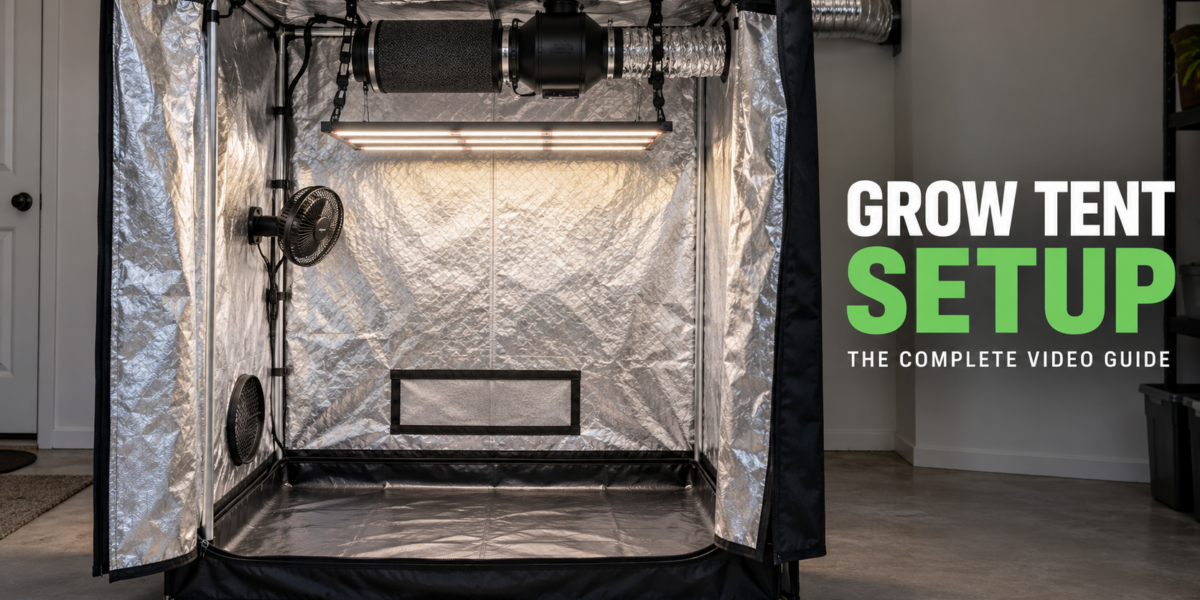
Complete Grow Tent Setup: Four Videos, One Working Setup

Why Cannabis Leaves “Sweat”: Transpiration, Humidity and Healthy Clones









Featured Grow

How do I purchase your step by step seed to veg mean and feeding chart

fair point was going to res change tonight anyways think flip will happen this weekend anyways :)
I would flip now They’re still gonna grow for 3 weeks. There’s a point where they’ll get too big and…
no i didn’t yet waiting for the left plant to fill up more space in the tent and wanted to…
I miss angle draining and dunking. Good job responsive feeding.