


Best Oscillating Grow Tent Fan: 4-Fan Airflow Test

Short answer: in my 2021 four-fan test, the little Towkka-style portable fan fit a 3×3 tent best because it could wrap around a pole, tilt and oscillate. The Genesis moved plenty of air for the money but was awkward to mount. The useful lesson today is not the old ranking—it is to choose a fan that stays attached, reaches the canopy and creates gentle movement without blasting one spot.
Video chapters
- 0:01 — Why a tent needs internal air movement
- 0:19 — Gentle seedling airflow
- 0:33 — Vegetative canopy circulation
- 1:29 — Leaves vibrating, not flapping
- 1:58 — Genesis 6-inch fan
- 2:40 — TianNorth test
- 3:28 — NTR portable fan
- 4:20 — Towkka-style fan
- 5:11 — Power-extension tradeoff
Timestamp links open the standard HWGrow pop-out player at the selected moment without losing your reading position.
The part of the old test that still matters
- Air movement: use enough airflow to keep the canopy gently moving, not folding or constantly flapping.
- Mount security: a powerful fan is useless if its clip slides down a tent pole or can fall into the canopy.
- Reach: check tilt and oscillation after the tent is full, not only when it is empty.
- Coverage: aim through or above the canopy and correct dead zones instead of blasting one plant.
- Environment: circulation mixes the air inside the tent; the exhaust system still removes heat and moisture.
A correction to the original explanation
The old video says wind in flower helps create strong buds because cannabis uses wind for pollination. That connection is wrong. Female flowers do not need pollen to build unseeded flower, and pollination would create seeds. The practical reasons for internal fans are to mix the air, reduce stagnant humid pockets, help leaves exchange heat and moisture, and support an even environment.
Penn State’s greenhouse disease-risk guidance notes that good circulation can reduce relative humidity and inhibit gray mold activity. That does not mean “more wind is better.” A dry, curled or wind-burned edge is a sign to increase distance, reduce speed or change the angle.

How the four historical fans compared
Genesis 6-inch: strong airflow and good directional adjustment, but the clip did not grab a vertical tent pole securely in my setup.
TianNorth: a large body with weaker airflow than expected. Its flat clip limited mounting and the tested unit did not oscillate as advertised.
NTR portable: good speed control and battery operation, but it was expensive and mainly suited to hanging from an upper pole.
Towkka-style portable: the smallest fan, yet the flexible mount, tilt and oscillation gave it the best placement options in my 3×3 test.
For comparison, AC Infinity’s current grow-tent fan range describes purpose-built pole clamps, multiple oscillation settings and environment ratings on select current models. Those are manufacturer claims, so still verify the exact product page, certification and warranty.
AC Infinity savings: If you buy from AC Infinity directly, use code EVYGROWS at checkout for additional savings on eligible products.
Useful airflow tools
Oscillating tent fanMatch the clamp to your pole and confirm the full sweep clears plants and walls.View productSmall circulation fanA fixed fan can cover a dead zone when it is aimed past—not directly into—the canopy.View productTemperature/RH sensorUse readings above and below the canopy to find environmental dead zones.View productAffiliate disclosure: HWGrow may earn a commission from qualifying Amazon purchases at no additional cost to you. Equivalent current products can replace these links without changing the airflow method.
Pair circulation with the grow-tent exhaust and filter setup guide. If you want help placing fans in an unusual room, Ask HWGrow with the tent dimensions, fan models and canopy photos.
Frequently asked questions
Should grow-tent leaves move all the time?
A gentle vibration is a useful visual starting point. If leaves are folding, flapping hard or drying at the edges, reduce direct airflow.
Does an internal fan replace the exhaust fan?
No. An internal fan circulates air inside the tent. Exhaust equipment removes heat and moisture and brings replacement air into the space.
Which fan won the 2021 test?
The Towkka-style portable fan fit my 3×3 best, while the Genesis offered strong value. Both findings apply only to those historical units.
What matters most when buying a current tent fan?
Secure pole fit, useful oscillation clearance, controllable speed, suitable environment rating, verified safety certification, warranty and replacement support.
You may also like

PRO-MIX HP Review: What the Lab Test Actually Says

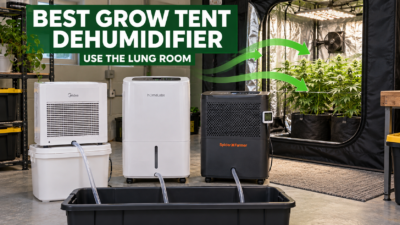
Best Grow Tent Dehumidifier: Why Mini Units Fail



Featured Grow

Mine wasnt that bad, i am low rate afib so just swing between 95 and high as 150 sometimes, up…

Yeah not fun, but as long as it helps thats what matters. Had my heartrate 200+bpm in the hospital for…
Tupac mine is for afib. Just Had cardio version the other week to get me out of it, worst case…
I was hoping for one at least that check the box's, but ya, having a couple is that much better.…
Heart cath ablation? Had one of those for Super Ventricular Tachycardia and it worked well