

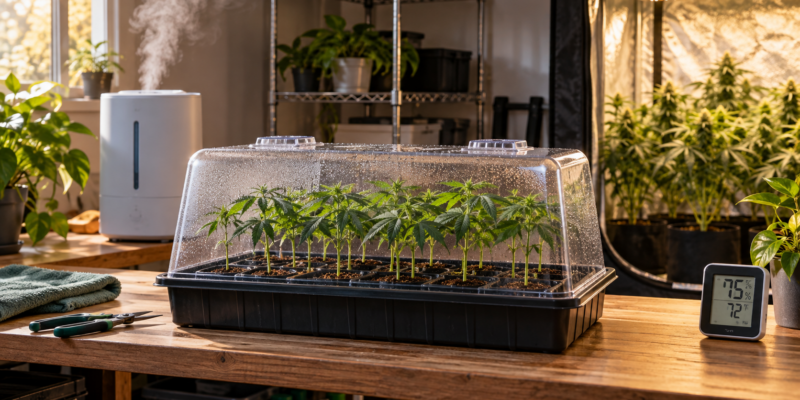
Best Grow Tent Humidifier: Why Young Plants Need More Humidity

Quick answer: A humidifier is most useful for seedlings and fresh clones because their small or missing root systems cannot replace water as fast as a dry room pulls it from their leaves. Start humid, then step the humidity down as roots and leaf mass develop. The point is not to keep a plant in a swamp forever. It is to make the transition slowly enough that the plant can keep up.
Why young plants need more humidity
Plants move water from the root zone, through the stem, and out through tiny leaf openings called stomata. That water loss is transpiration. A rooted plant can respond by pulling up more water. A new cutting cannot: it has leaves, but it does not yet have a working root system.
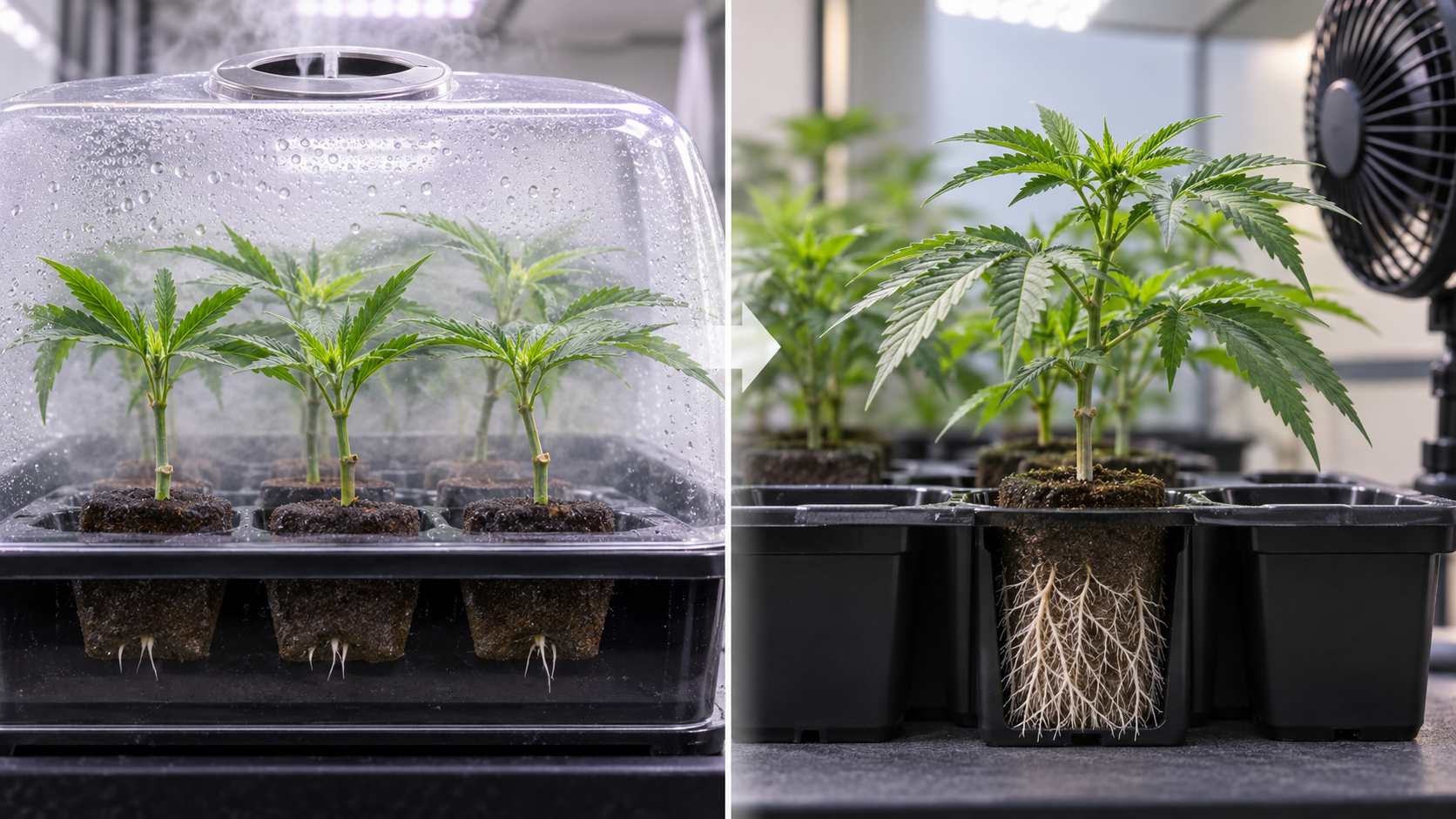
Higher relative humidity slows that loss. This is why propagation guides from UMass Extension and the University of Florida emphasize preventing unrooted cuttings from drying while roots form.
For the complete plain-language science, read How Plant Transpiration Controls Grow-Room Humidity.
Humidity should come down as the plant grows
I do not like one rigid number for every room. Leaf temperature, airflow, rooting, irrigation, cultivar and measurement error all matter. Use the ranges below as a starting point, then watch the plant and the room.
| Stage | Starting RH range | What you are trying to prevent |
|---|---|---|
| Fresh cuttings | About 75–85% | Leaf water loss before roots form. Use a dome or propagation space and exchange air. |
| Rooted clones / seedlings | About 65–75% | A sudden dry-air shock while the root system is still small. |
| Established vegetative plants | About 55–70% | Keeping the room so wet that the plant never acclimates to normal airflow. |
| Flower | About 45–55%, often lower late | Condensation and trapped moisture inside dense flowers. |
Do not drop a fresh clone from a humid dome into a dry tent in one jump. Open the vents, increase air exchange, and reduce humidity over several days while checking for droop. That gradual step-down lets new roots take over the job that the humid air was doing.
What actually matters in a humidifier
- Top-fill access: easier refills with less water near cords.
- Dark, cleanable reservoir: less light reaches the water, but the tank still needs regular cleaning.
- Adjustable output: enough control to avoid wet leaves and condensation.
- Target humidity control: useful for cycling, but verify it with a separate canopy sensor.
- Quiet/dark mode: no unnecessary display light during the plant’s night.
- Enough runtime: it should survive the longest unattended period without running dry.
Yes, a humidifier can go inside the tent
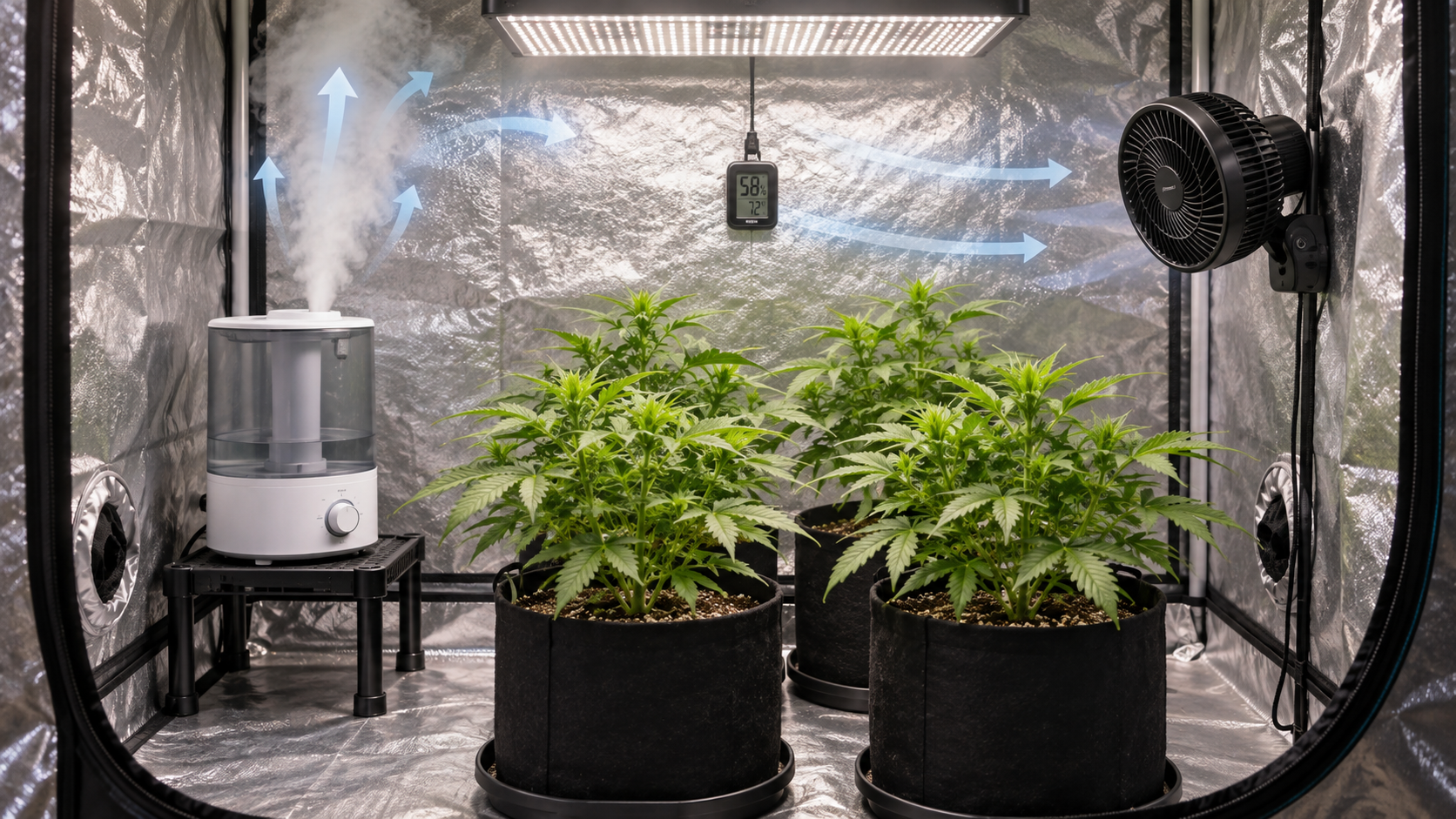
A cool-mist ultrasonic or evaporative humidifier can sit inside the grow tent when it is stable, kept away from plugs and power strips, and does not blow directly onto leaves. These units add little practical heat; evaporation can even cool the immediate mist path slightly. A warm-mist or steam model is different because it heats water on purpose and can raise the tent temperature.
A compressor dehumidifier is the opposite. Its compressor and condenser intentionally release heat into the surrounding air, which is why I normally keep a full-size dehumidifier in the lung room. Wherever the humidifier sits, control it with a separate canopy-height sensor and stop before mist, condensation or wet leaves appear.
Watch the original feature test
The exact models in this older comparison are discontinued, but the practical lessons still apply: top-fill beats wrestling with a dripping tank, a dark reservoir is easier to manage than a clear one, and the controls matter more than the logo.
- 0:24 — Clear-tank buildup
- 1:07 — Top-fill versus bottom-fill
- 2:58 — Target humidity controls
- 3:24 — Hot-mist placement warning
Put the sensor where the plant lives
The sensor built into a humidifier sits beside its own mist plume. That is the worst place to decide what the middle of the canopy is experiencing. Put a separate thermometer/hygrometer at canopy height, out of direct mist, and compare it with the lung room.
If the tent is too humid, the solution is not a smaller humidifier. Read the grow-tent dehumidifier guide and treat the lung room. If the canopy is thick, also use the airflow guide. Late-flower humidity problems should be treated before they become bud rot.
Keep the humidifier clean
A dark tank is not a self-cleaning tank. The EPA warns that ultrasonic and impeller humidifiers can disperse minerals and microorganisms from dirty tanks. Empty and dry the unit frequently, clean it on the manufacturer’s schedule, and use low-mineral water when the manual allows it.
 6L top-fill humidifierA dark-reservoir starting point with adjustable output and target control. Verify the current seller and exact generation.
 Independent hygrometerCheck canopy and lung-room conditions instead of trusting the sensor built into one appliance.
 Seed tray and humidity domeProtect unrooted cuttings, then open the vents gradually as roots develop.
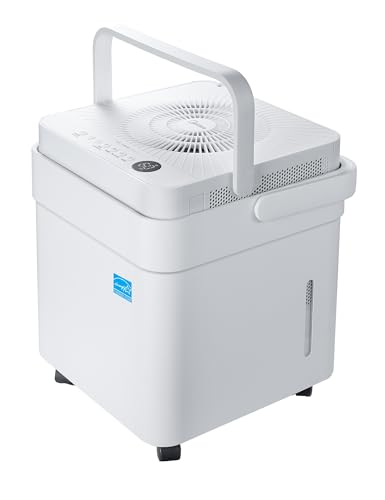 Midea Cube dehumidifierFor an overly humid lung room. Use continuous drain and keep the compressor heat outside the tent.
Affiliate disclosure: HWGrow may earn a commission from qualifying purchases at no extra cost to you. Verify the exact model, seller and specifications before buying.
Sources
You may also like

Mars Hydro FC4000 vs Spider Farmer SE4500: Side-by-Side Test

AC Infinity IONFRAME A7 Review: Best 2×4 Grow Light I’ve Tested?




Featured Grow
 Jul 2026 — White Iverson by Selfie Seeds +2 more
White Iverson × Selfie Seeds, Pink Strawberry × Selfie Seeds, Purple Berry × Selfie Seeds • Soil • Started Jul 25, 2026
View journal
Jul 2026 — White Iverson by Selfie Seeds +2 more
White Iverson × Selfie Seeds, Pink Strawberry × Selfie Seeds, Purple Berry × Selfie Seeds • Soil • Started Jul 25, 2026
View journal
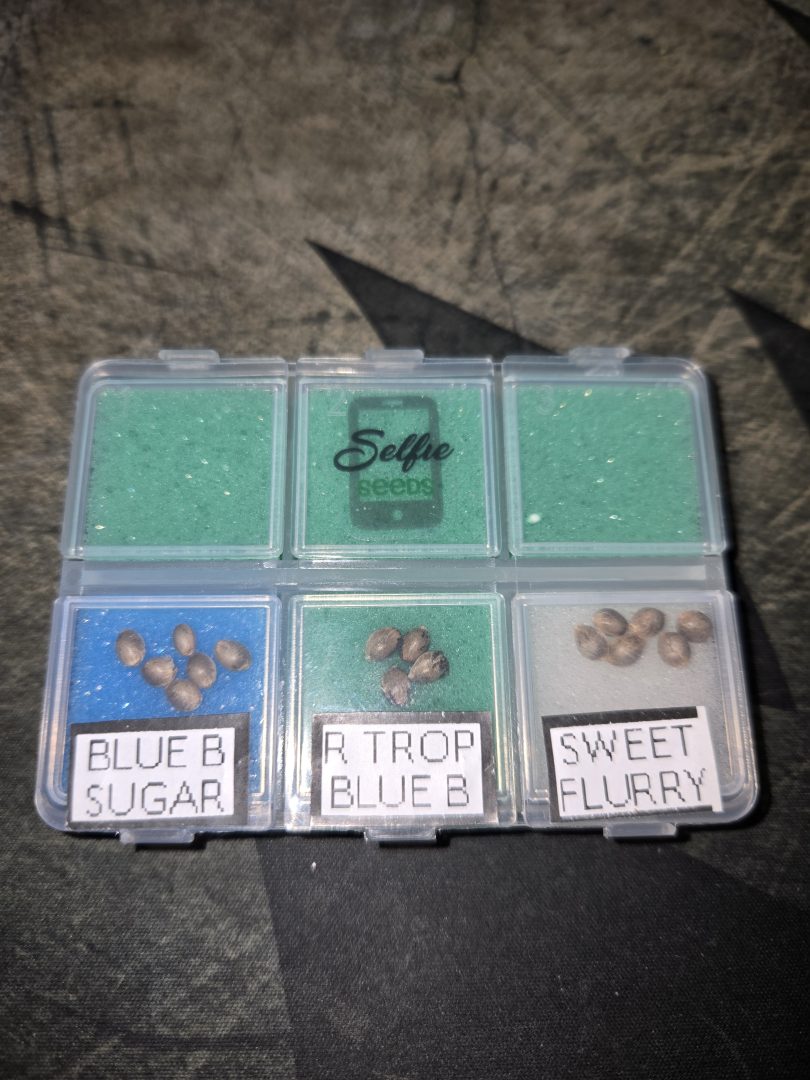 First Selfie Seeds Grow (Blueberry Sugar, Tropical Blueberry, and Sweet Flurry)
Blueberry Sugar × Selfie Seeds, Tropical Blueberry × Selfie Seeds, Sweet Flurry × Selfie Seeds • Soil • Started May 27, 2026
View journal
First Selfie Seeds Grow (Blueberry Sugar, Tropical Blueberry, and Sweet Flurry)
Blueberry Sugar × Selfie Seeds, Tropical Blueberry × Selfie Seeds, Sweet Flurry × Selfie Seeds • Soil • Started May 27, 2026
View journal
Awesome It’ll be a bit chlorophyllie but definitely let me know your opiniones

Walked in this morning before lights out and they are already bouncing back pretty good.
Awesome, fingers crossed for you
Nice LSTing Looks perfectly symmetric

Bananas!!!!! I knew I forgot something today. Thanks, gotta hit the store up in the am anyway. Coming off night,…